






















The VAR Decisions That Football Fans Will Never Forget
VAR was introduced to eliminate the kind of refereeing mistakes that could decide championships, knock teams out of tournaments or change football history. However, some of its most famous interventions have produced exactly the opposite result.
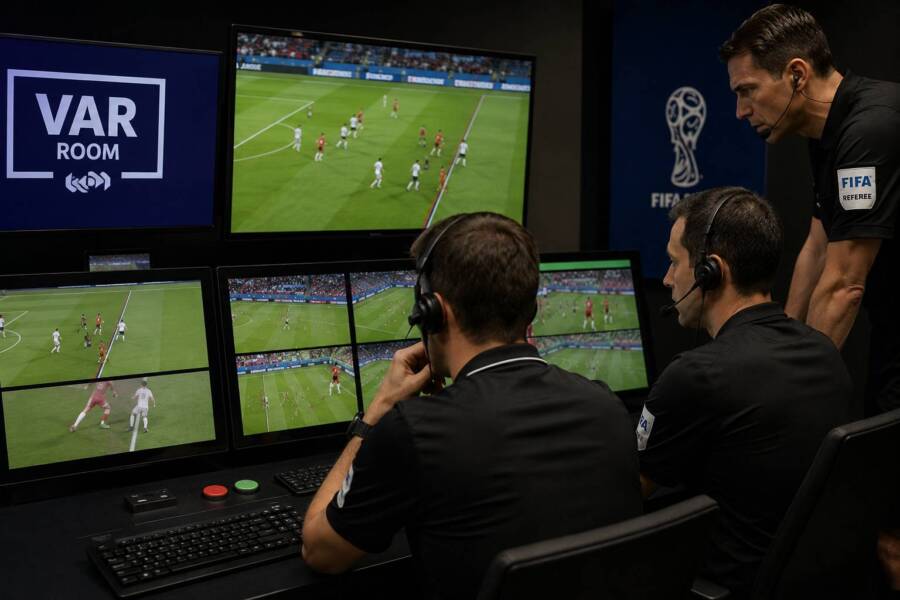
Instead of ending arguments, VAR has occasionally created controversies that lasted for weeks, months or even years.
Manchester City vs Tottenham: A Night of VAR Chaos
The 2019 Champions League quarter-final between Manchester City and Tottenham remains one of the most dramatic examples of how VAR can completely transform a football match.
Fernando Llorente scored Tottenham’s decisive goal after the ball appeared to make contact with his arm before entering the net. The referee reviewed the incident but allowed the goal to stand under the handball interpretation being used at the time. Tottenham eventually advanced on away goals after an extraordinary 4–4 aggregate draw.
But the drama was not finished.
In stoppage time, Raheem Sterling scored what appeared to be the goal that would send Manchester City into the semi-finals. The stadium exploded. Players celebrated wildly, Pep Guardiola ran down the touchline and City supporters believed they had witnessed one of the greatest moments in the club’s history.
Seconds later, VAR ruled that Sergio Agüero had been offside during the build-up.
The goal was cancelled, the celebrations suddenly stopped and Tottenham advanced.
Technically, the decision may have been correct. Emotionally, however, the moment demonstrated one of VAR’s biggest problems: fans could no longer celebrate a goal with complete confidence.
Every goal now came with an invisible question mark.
Jordan Pickford’s Challenge on Virgil van Dijk
Another major controversy occurred during the Merseyside derby between Everton and Liverpool in October 2020.
Everton goalkeeper Jordan Pickford made a dangerous challenge on Virgil van Dijk inside the penalty area. Van Dijk was ruled offside before the collision, and Pickford was not punished for the challenge.
The Liverpool defender suffered a serious knee injury and required surgery. Referee Michael Oliver later acknowledged that the officials became too focused on the offside process instead of considering the challenge as a separate incident.
For many supporters, this incident exposed a serious weakness in the system.
VAR had access to multiple camera angles and enough time to examine the challenge. Yet the final outcome still appeared obviously wrong to millions of viewers.
The problem was not that the technology failed to capture the incident. The cameras showed exactly what had happened.
The failure came from the way the officials interpreted and processed the information.
This is an important distinction. VAR is not an independent robot making decisions. Human referees still decide what should be reviewed, which images are important and how the Laws of the Game should be applied.
The Luis Díaz Offside Error
Perhaps no incident damaged trust in Premier League VAR more than Luis Díaz’s disallowed goal against Tottenham in September 2023.
Díaz scored for Liverpool, but the assistant referee raised the flag for offside. VAR reviewed the incident and correctly determined that the Liverpool forward had actually been onside.
However, because of a communication failure, the VAR mistakenly believed the on-field decision had been to award the goal. The official said the check was complete, unintentionally confirming the incorrect offside decision.
The match restarted before the mistake could be corrected.
PGMOL later admitted that the goal had been wrongly disallowed and released the VAR audio explaining how the communication breakdown occurred.
The recording was shocking because it showed that the technology had produced the correct information. The officials could see that Díaz was onside.
The goal was still disallowed because the people operating the system misunderstood one another.
This became a perfect example of why VAR controversies are not always technological failures. Sometimes they are failures of language, concentration, protocol and pressure.
The Problem With “Clear and Obvious”
VAR is generally supposed to intervene when the referee has made a “clear and obvious error.” That sounds reasonable, but the expression has become one of the most confusing parts of the entire system.
How obvious must an error be?
Should VAR correct a decision that is probably wrong, or only one that is unquestionably wrong?
Two referees can watch the same replay and reach completely different conclusions. One may see serious foul play, while another sees an ordinary football challenge. One may consider an arm to be in an unnatural position, while another believes the player had no time to react.
This is why supporters frequently see similar incidents punished differently from one week to the next.
The cameras may be consistent. Human interpretation is not.
Has Semi-Automated Offside Solved the Problem?
Football authorities have attempted to improve VAR through semi-automated offside technology.
The system uses optical player tracking to help identify the positions of attackers and defenders. It can place the virtual offside line more efficiently and produce clearer graphics for television viewers and supporters inside stadiums.
The Premier League introduced the technology during the final weeks of the 2024/25 season and continued using it throughout 2025/26. According to the league, it reduced the average time required for an offside decision by approximately 27 seconds.
That is a genuine improvement.
Faster decisions reduce long interruptions and make the process feel less painful. Automated tracking can also prevent officials from manually placing lines on the wrong defender or selecting an inaccurate frame.
However, semi-automated technology does not eliminate every argument.
Supporters still question whether a player should be punished for being offside by a tiny part of the body. The technology may prove that a shoulder, knee or foot is marginally ahead, but accuracy does not automatically make the rule feel fair.
In other words, football may now be able to measure offside more precisely than ever before. The bigger question is whether fans want matches decided by margins that would be almost impossible for any assistant referee to detect with the human eye.
VAR’s Biggest Failure: The Loss of Trust
Individual mistakes are unavoidable in football. Referees made errors before VAR, and they will continue making them with VAR.
The deeper problem is that supporters were promised something close to certainty.
When fans see several officials, dozens of camera angles, slow-motion replays and advanced tracking systems, they naturally expect the final decision to be correct. When it is not, the frustration becomes greater than it would have been after a traditional refereeing mistake.
VAR raised expectations without completely removing subjectivity.
That is why every controversial decision now produces the same uncomfortable question:
If the officials can still get major calls wrong after watching the incident repeatedly, what exactly is VAR solving?

TechnologyHQ is a platform about business insights, tech, 4IR, digital transformation, AI, Blockchain, Cybersecurity, and social media for businesses.
We manage social media groups with more than 200,000 members with almost 100% engagement.