






















Black Mirror Predictions That Came True (Updated for 2026)
Meta Description: Discover the most shocking Black Mirror predictions that came true. From AI companions and deepfakes to brain implants and digital surveillance, reality is catching up with fiction.
Black Mirror Predictions That Came True: 15 Times the Show Was Ahead of Its Time
When Black Mirror first premiered in 2011, many viewers saw it as nothing more than a dark science-fiction anthology. The series imagined a future where technology controlled nearly every aspect of human life, often with disturbing consequences.
More than a decade later, however, many of those fictional ideas no longer seem impossible. Artificial intelligence writes emails, deepfake videos fool millions of people, smart glasses are making a comeback, and brain-computer interfaces are moving from research labs into real-world testing.
While Black Mirror didn’t literally predict the future, it did an extraordinary job of exploring where technological trends could lead. Looking back in 2026, some episodes feel less like fiction and more like documentaries.
Here are 15 Black Mirror predictions that have already become reality.
1. AI Companions That Mimic Real People
Episode: Be Right Back
One of the show’s most emotional episodes imagined an AI that recreated a deceased loved one using their online conversations, photos, and videos.
Today, AI has made this concept surprisingly realistic.
Modern chatbots can imitate personalities, remember conversations, and generate human-like responses. Some services even allow users to create digital versions of themselves or loved ones using voice cloning and personal data.
Although today’s technology isn’t as advanced as the one shown in the episode, the foundation already exists.
2. Deepfake Videos
Years before the general public had heard the word “deepfake,” Black Mirror warned about the dangers of manipulated digital identities.
Today, AI-generated videos can make virtually anyone appear to say or do things that never happened.
Deepfakes have become a major concern for governments, journalists, and cybersecurity experts because they can spread misinformation and damage reputations in minutes.
3. Social Credit Systems
Episode: Nosedive
Perhaps one of the most famous episodes, Nosedive portrays a society where every social interaction affects a person’s rating.
A higher score means better jobs, housing, and opportunities.
Although no country has implemented the exact system shown in the series, many parts of modern life already rely heavily on ratings:
- Ride-sharing apps
- Online marketplaces
- Freelance platforms
- Food delivery services
- Customer review systems
In many ways, reputation has become a form of digital currency.
4. AI That Creates Personalized Content
Episode: Joan Is Awful
This episode imagined a streaming platform capable of instantly generating TV shows based on a person’s daily life.
That idea sounded absurd when the episode premiered.
Now AI can write articles, generate videos, create images, compose music, and even produce personalized advertisements tailored to individual users.
The entertainment industry is rapidly adopting generative AI, making this episode feel surprisingly realistic.
5. Brain-Computer Interfaces
Episode: The Entire History of You
In this unforgettable episode, people replay memories through implants placed inside their brains.
While we can’t replay memories yet, brain-computer interface technology has advanced rapidly.
Researchers have demonstrated systems that allow people to control computers, robotic limbs, and communication devices using brain signals alone.
This field is still developing, but the similarities are impossible to ignore.
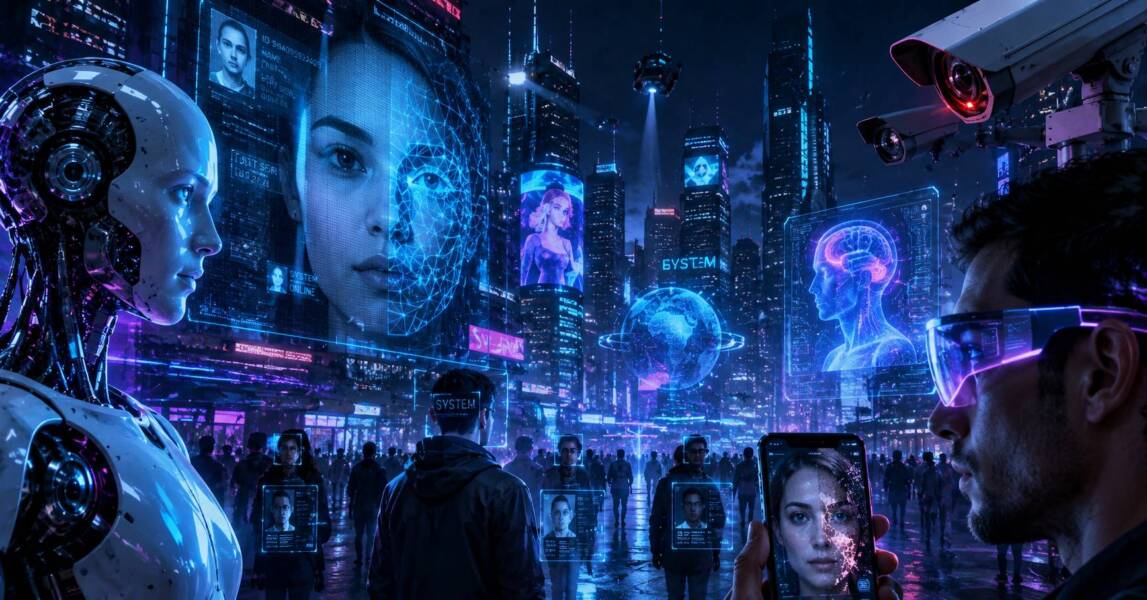
6. Constant Digital Surveillance
Almost every Black Mirror episode shares one recurring theme: someone is always watching.
Today, surveillance cameras are everywhere.
Facial recognition systems identify individuals in airports, shopping centers, and public spaces. Smartphones continuously collect location data, while connected devices generate detailed information about daily habits.
Privacy has become one of the defining technology debates of the decade.
7. Smart Glasses Powered by AI
For years, smart glasses struggled to gain mainstream attention.
That is changing quickly.
Modern AI-powered glasses can answer questions, translate conversations, recognize objects, capture photos, and provide navigation without requiring users to look at a phone.
Several major technology companies are investing heavily in wearable AI devices, bringing us closer to the futuristic interfaces shown in Black Mirror.
8. Voice Cloning Technology
AI can now recreate a person’s voice after hearing only a short audio sample.
The results have become remarkably convincing.
Voice cloning has useful applications, such as helping people who lose their ability to speak, but it also raises concerns about fraud, identity theft, and misinformation.
The show repeatedly warned about technology that blurs the line between reality and simulation.
9. Hyper-Personalized Advertising
Every click, search, purchase, and video watched online helps build a digital profile.
Modern advertising platforms use AI to predict what consumers are likely to buy before they even search for it.
The result is an internet where advertisements often feel uncannily personal—a theme frequently explored throughout Black Mirror.
10. Digital Clones
Generative AI has made it possible to create realistic digital versions of people.
These avatars can speak, answer questions, appear in videos, and even represent businesses without requiring a human to be present.
Although they aren’t conscious beings like those portrayed in the series, they demonstrate how rapidly digital identity is evolving.
11. Algorithm-Controlled Lives
Recommendation algorithms influence nearly everything people consume online.
Movies.
Music.
News.
Shopping.
Dating.
Even job opportunities.
Many people don’t realize how much of their daily life is guided by algorithms deciding what deserves their attention.
That invisible influence has long been one of Black Mirror’s central warnings.
12. Virtual Reality Becoming More Immersive
Episodes such as Striking Vipers explored virtual environments that felt indistinguishable from reality.
Today’s virtual reality headsets offer increasingly realistic experiences, with improved graphics, eye tracking, hand tracking, and spatial computing.
While full sensory immersion remains science fiction, each generation of hardware narrows the gap.
13. AI-Generated Influencers
Virtual influencers now attract millions of followers across social media platforms.
These computer-generated personalities collaborate with brands, produce content, and engage with audiences as though they were real people.
Some followers don’t even realize the creators they admire aren’t human.
14. Smart Homes That Know Everything
Voice assistants have evolved far beyond setting timers.
Today’s connected homes can automatically adjust lighting, temperature, security systems, appliances, and entertainment based on routines and preferences.
Convenience has increased dramatically—but so has the amount of personal data collected inside people’s homes.
15. Emotional Relationships With Artificial Intelligence
One of Black Mirror’s recurring themes is emotional dependence on technology.
That prediction has become increasingly relevant.
Millions of people now interact daily with conversational AI, forming routines and emotional connections with digital assistants.
While these systems aren’t sentient, they demonstrate how quickly technology can become part of human relationships.
Which Black Mirror Prediction Could Come True Next?
Some fictional technologies remain out of reach—for now.
Scientists continue researching:
- Advanced brain implants
- Artificial general intelligence (AGI)
- Fully immersive virtual reality
- Digital consciousness
- Memory enhancement technologies
- Autonomous AI assistants capable of making complex decisions
If technological progress continues at its current pace, some of today’s science fiction may become tomorrow’s everyday reality.
Why Black Mirror Still Matters
The brilliance of Black Mirror isn’t that it accurately predicted specific inventions.
Instead, it understood something more important: technology is rarely good or bad by itself.
Its impact depends on how society chooses to use it.
Every new innovation offers incredible opportunities while creating new ethical questions about privacy, identity, misinformation, and human connection.
That balance is exactly why the series continues to feel so relevant more than fiftesen year after it first aired.
Final Thoughts
Looking back, many of the most unsettling ideas in Black Mirror no longer seem impossible.
AI writes stories.
Deepfakes blur reality.
Smart glasses are returning.
Brain-computer interfaces continue advancing.
Algorithms influence our daily decisions.
None of these technologies exactly match the show’s dystopian vision—but together, they suggest we are living in a world that increasingly resembles the one Charlie Brooker imagined.
Perhaps the most important lesson from Black Mirror isn’t that it predicted the future.
It’s that it challenged us to think carefully about the future we are building.
Frequently Asked Questions
Did Black Mirror actually predict the future?
Not literally. The series extrapolated emerging technologies and social trends, many of which have since become part of everyday life.
Which Black Mirror episode is most realistic?
Many viewers consider Nosedive, Be Right Back, The Entire History of You, and Joan Is Awful among the episodes that most closely resemble current technological developments.
Is AI making Black Mirror more realistic?
Yes. Advances in generative AI, voice cloning, image creation, and digital assistants have made several concepts explored in the series feel far less fictional than they did a decade ago.
What technology from Black Mirror doesn’t exist yet?
Fully replayable memories, conscious digital copies of people, and complete brain-to-brain communication remain largely speculative, although research in these areas continues to progress.

TechnologyHQ is a platform about business insights, tech, 4IR, digital transformation, AI, Blockchain, Cybersecurity, and social media for businesses.
We manage social media groups with more than 200,000 members with almost 100% engagement.