






















Every time a mysterious fireball streaks across the night sky, people ask the same question:
Could scientists have predicted it?
That question gained fresh attention after reports of a suspected meteorite over New Jersey sparked excitement across social media. Videos captured a bright object crossing the sky within seconds, while many residents wondered whether Earth had narrowly avoided something much larger.
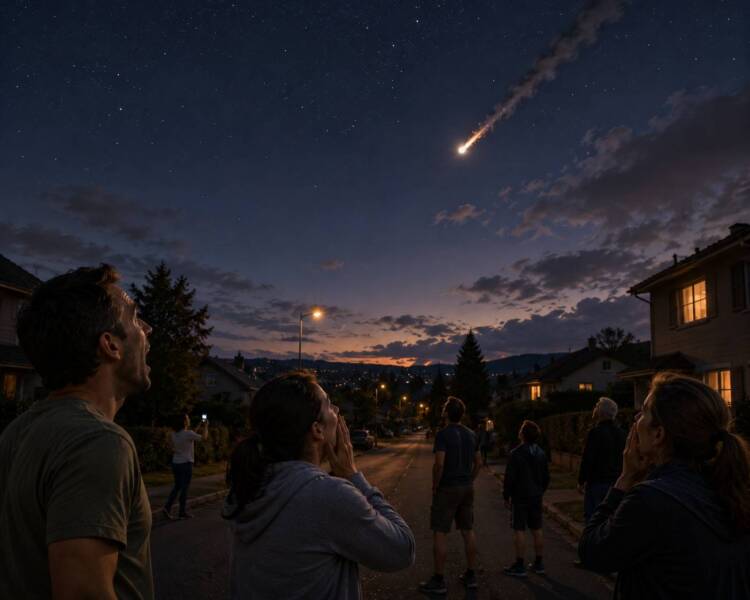
Events like these highlight an important reality: although humanity has become remarkably good at tracking potentially dangerous asteroids, predicting the exact moment and location where a small meteorite will enter Earth’s atmosphere remains one of astronomy’s biggest challenges.
The good news is that technology is advancing rapidly. Artificial intelligence, satellite networks, powerful telescopes, radar systems, and space agencies worldwide are transforming our ability to monitor objects traveling through our solar system.
Here’s how modern meteorite prediction works—and why incidents like the one in New Jersey are helping scientists improve future detection.
What’s the Difference Between an Asteroid, Meteor, and Meteorite?
Many people use these terms interchangeably, but they describe different stages of the same object.
- Asteroid: A rocky object orbiting the Sun, often millions of kilometers away from Earth.
- Meteor: The bright streak of light produced when a small space rock burns up in Earth’s atmosphere.
- Meteorite: Any fragment that survives the journey and reaches the ground.
Understanding this distinction is essential because predicting an asteroid’s orbit is much easier than predicting exactly where a tiny meteorite fragment will eventually land.
Why Predicting Meteorite Falls Is So Difficult
Earth is constantly being bombarded by material from space.
Scientists estimate that tens of thousands of tons of cosmic dust and small rocks enter Earth’s atmosphere every year.
Fortunately, almost all of these objects are tiny.
Most burn up completely before reaching the surface, producing nothing more than a spectacular light show.
The challenge lies in detecting them before they arrive.
Small meteoroids often measure only a few centimeters across.
At that size, they are virtually invisible until they’re extremely close to Earth.
By then, there may be only minutes—or even seconds—before atmospheric entry.
How Modern Technology Tracks Space Rocks
Fortunately, larger objects are much easier to monitor.
Today’s planetary defense systems combine multiple technologies working together around the clock.
1. Space Telescopes
Ground-based observatories scan the sky every night searching for moving objects.
Advanced software compares thousands of images, automatically identifying anything that changes position against the background stars.
This allows astronomers to discover new asteroids almost daily.
2. Radar Observation
When an asteroid passes relatively close to Earth, radar systems provide incredibly precise measurements.
Scientists can estimate:
- size
- rotation
- speed
- surface shape
- trajectory
Radar dramatically improves impact predictions.
3. Artificial Intelligence
AI has become one of the biggest breakthroughs in planetary defense.
Machine learning algorithms can:
- analyze millions of telescope images
- identify faint moving objects
- eliminate false positives
- calculate orbital paths
- predict future positions faster than traditional methods
Without AI, the sheer volume of astronomical data would overwhelm researchers.
4. Satellite Monitoring
Earth-orbiting satellites constantly monitor the atmosphere.
Large meteors produce bright flashes detectable from space.
Satellites help scientists estimate:
- entry speed
- explosion altitude
- travel direction
- possible landing zone
This information is invaluable when researchers search for meteorites after a fall.
The New Jersey Incident
The recent reports of a bright object crossing the skies above New Jersey generated enormous public interest.
Videos quickly spread across social media, with many viewers wondering whether it was:
- a meteor
- space debris
- an aircraft
- or something else entirely.
Although investigations typically take time, events like this demonstrate how modern technology allows scientists to gather information from multiple sources almost immediately.
Researchers analyze:
- eyewitness videos
- dashboard cameras
- security cameras
- weather radar
- satellite imagery
- astronomical observations
Combining these data sources often makes it possible to reconstruct the object’s trajectory with remarkable accuracy.
Can Scientists Predict Meteorite Impacts Before They Happen?
The answer is both yes and no.
Yes—for large asteroids.
Objects hundreds of meters across are usually detected years—or even decades—in advance.
Scientists continuously monitor thousands of Near-Earth Objects (NEOs).
Their orbits are recalculated every time new observations become available.
This gives space agencies enough time to evaluate potential risks.
No—for small meteorites.
Tiny rocks only a few centimeters across usually remain undetected until they enter Earth’s atmosphere.
Fortunately, these objects rarely pose any danger because they burn up almost completely.
The Role of NASA’s Planetary Defense
NASA has significantly expanded its planetary defense capabilities over the past decade.
Dedicated programs monitor millions of celestial objects looking for any that could threaten Earth.
One of the biggest milestones came with the DART mission, which demonstrated that humanity can intentionally alter an asteroid’s orbit.
Although DART focused on asteroid deflection rather than prediction, it proved that planetary defense is no longer just science fiction.
AI Is Revolutionizing Meteorite Detection
Artificial intelligence continues to improve nearly every aspect of space monitoring.
Modern algorithms can:
- detect objects humans might miss
- process telescope images instantly
- calculate impact probabilities
- estimate landing zones
- identify unusual orbital behavior
Researchers expect AI to become even more accurate as future observatories generate exponentially more data.
Global Networks Are Working Together
Meteorite tracking is now an international effort.
Scientists share observations between:
- observatories
- universities
- government agencies
- amateur astronomers
When a fireball appears, reports from different countries can often be combined to reconstruct its entire flight path.
Crowdsourced smartphone videos have become surprisingly valuable for scientific analysis.
Could We Ever Predict Every Meteorite?
Probably not.
The universe contains countless tiny rocks traveling at extraordinary speeds.
Many approach Earth from the direction of the Sun, making them almost impossible to detect using ground-based telescopes.
However, upcoming technologies promise major improvements.
Future systems may include:
- next-generation infrared telescopes
- AI-powered sky surveys
- more sensitive radar
- space-based observatories positioned farther from Earth
- autonomous detection satellites
These innovations could significantly increase the number of incoming objects detected before atmospheric entry.
What Should You Do If You See a Meteor?
Most meteors are harmless.
If you witness one:
- enjoy the spectacle
- record the time and location
- take photos or videos if possible
- report significant fireballs to local astronomical organizations
Your footage may actually help scientists reconstruct the object’s trajectory.
The Future of Meteorite Prediction
Every year, astronomers discover new techniques that make Earth’s planetary defense systems smarter.
Artificial intelligence is reducing detection times.
Satellites provide better atmospheric monitoring.
New telescopes can spot fainter objects farther away than ever before.
While predicting every small meteorite remains impossible today, the technology improves with every observation.
The New Jersey incident serves as another reminder that our planet exists within a dynamic cosmic environment—and that science is becoming increasingly capable of understanding it.
Final Thoughts
So, can technology predict meteorite falls?
The answer depends on the object’s size.
Large asteroids can often be tracked years before they approach Earth, allowing scientists to calculate their orbits with remarkable precision. Smaller meteoroids, however, usually remain undetected until they enter the atmosphere, where they create the brilliant fireballs that capture public attention.
Even so, advances in artificial intelligence, satellite monitoring, radar, and global telescope networks are steadily improving our ability to detect and analyze these events. Each incident—including the recent reports over New Jersey—provides valuable data that helps researchers refine future prediction models.
As new observatories and AI-driven detection systems come online, humanity is moving closer to a future where more objects can be identified earlier, giving scientists an increasingly detailed picture of the ever-changing space environment surrounding Earth.

TechnologyHQ is a platform about business insights, tech, 4IR, digital transformation, AI, Blockchain, Cybersecurity, and social media for businesses.
We manage social media groups with more than 200,000 members with almost 100% engagement.