





















If you’ve ever stood in front of a world-famous landmark and felt a weird rush of excitement—like you’re suddenly part of every travel documentary ever—you’re not alone. Landmarks have that effect. They’re like humanity’s greatest hits album: instantly recognizable, always photogenic, and packed with backstories that make them even cooler.
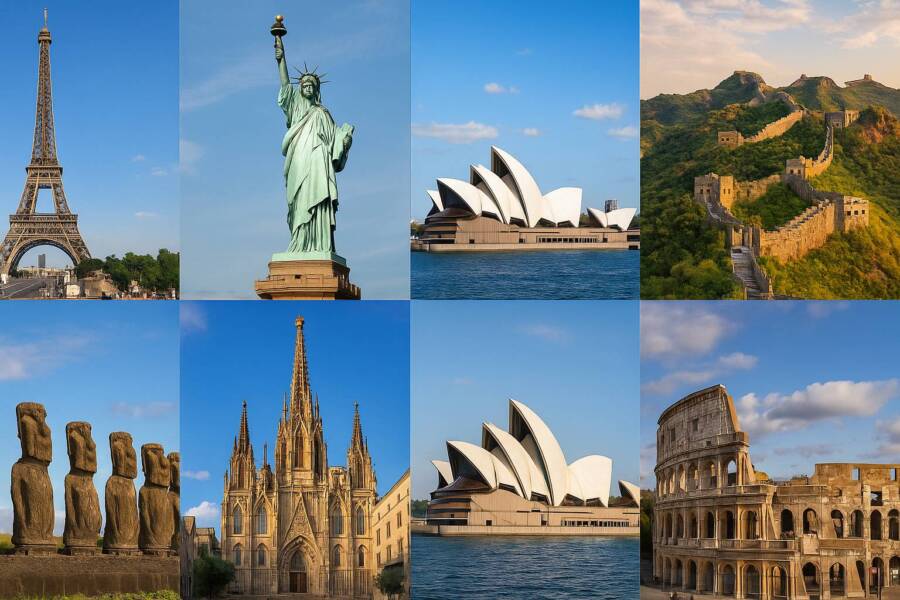
This guide is the casual, fun, super-readable version of learning about the world’s most iconic cityscapes. No boring textbook jargon. No heavy academic vibes. Just the good stuff—stories, secrets, surprises, and the cultural meanings that make these places legendary.
So grab your imaginary passport. Let’s explore.
Why Landmarks Hit Us Right in the Feels
Why do landmarks matter so much? Why do we travel across oceans just to stand in front of giant buildings or old stones? A few reasons:
- They’re symbols. They represent entire cultures, histories, and identities.
- They’re gathering spots. People meet, celebrate, protest, dream, and selfie in these places.
- They’re memory anchors. Travel isn’t just about seeing something—it’s about feeling something.
- They’re bragging-rights generators. Anyone who says they didn’t post a landmark on social media is lying.
But the biggest reason? Landmarks tell stories. Legends. Struggles. Beautiful accidents. Ambitious ideas. Human emotion carved into stone and steel.
Let’s dive into those stories.
Eiffel Tower, Paris – The Iron Lady With a Drama-Filled Origin
The Eiffel Tower might be the most famous structure on the planet—and yet it was originally supposed to be temporary. Built for the 1889 World’s Fair, people hated it at first. Really hated it. Artists called it a disgrace. Newspapers roasted it daily.
Now? She’s the glamorous queen of Paris.
What makes her iconic?
- The shape is instantly recognizable.
- The nighttime sparkle show is pure romance.
- She’s a symbol of innovation, creativity, and unapologetic French style.
A surprising truth:
Gustave Eiffel used the top as a private lab and lounge. The man had the best penthouse in Europe.
Statue of Liberty, New York – The Queen of Symbolism
Lady Liberty isn’t just a statue; she’s a statement. A giant, copper, torch-wielding statement.
Gifted by France (because apparently France loves making giant metal things), she became one of the strongest symbols of freedom, immigration, and new beginnings.
Why she’s legendary:
- The torch = enlightenment.
- The broken shackles = liberation.
- The height = towering hope.
Visiting the crown gives you one of the most unique views of Manhattan—if you’re willing to climb all those stairs.
The Colosseum, Rome – The Original Stadium Spectacle
Think of the Colosseum as the world’s first big-league arena—before sports were sports. Gladiators, naval reenactments, wild animal battles… Romans went all in on entertainment.
Why it still blows minds:
- It held around 50,000 people.
- It had shaded seating (ancient VIP style).
- It’s still standing after nearly 2,000 years.
Fun fact:
They sometimes flooded the arena for mock sea battles. Imagine explaining that to modern stadium engineers.
Sydney Opera House, Australia – The Beautiful Accident
The Sydney Opera House looks perfectly futuristic now, but in the 1960s it was considered wildly impractical. The curved shell-like roof was so hard to engineer that the architect, Jørn Utzon, actually resigned before it was completed.
Still, the result is breathtaking.
What makes it unforgettable:
- The design is like sails, shells, or abstract art (depending on your vibe).
- The harbor backdrop is unbeatable.
- The acoustics are near-perfect.
Taj Mahal, India – The Love Letter in Marble
The Taj Mahal is famous worldwide as a monument of love—and honestly, it lives up to the hype. Built by Emperor Shah Jahan in memory of his wife Mumtaz Mahal, the entire structure is one giant, shimmering love story.
Why it feels magical:
- The symmetry is flawless.
- The marble glows differently depending on the light.
- The craftsmanship is unreal—stone inlays, carvings, domes, delicate patterns.
A dreamy detail:
At sunrise, it blushes a soft pink.
Burj Khalifa, Dubai – The Record-Breaker
The Burj Khalifa isn’t just tall. It’s ridiculously tall. The tallest building in the world tall. The “you need extra elevators just to reach halfway” tall.
Why it’s iconic:
- It redefined modern architecture.
- The engineering is next-level.
- The views are unmatched.
Temperature difference from bottom to top? Around 15 degrees. That’s a microclimate in one building.
Machu Picchu, Peru – The Hidden City of the Clouds
High in the Andes sits Machu Picchu, the ancient Inca city that makes you question everything you know about engineering.
Reasons it leaves visitors speechless:
- It was built without wheels, iron tools, or mortar.
- It blends naturally into the mountains.
- The views are beyond cinematic.
It’s one of those rare places that feels sacred even if you’re not spiritual.
Big Ben, London – The Clock That Defines the City
London has many famous sights, but Big Ben is the classic. Technically, the name refers to the bell, but most people use it for the entire tower.
What makes it memorable:
- It’s the symbol of London’s identity.
- The architecture is as elegant as it is iconic.
- The clock itself is extremely accurate.
Rain or shine, it looks good in every postcard.
Christ the Redeemer, Rio de Janeiro – The Guardian in the Sky
Arms wide open, Christ the Redeemer watches over Rio from the peak of Corcovado Mountain. It’s both a cultural symbol and a breathtaking viewpoint.
Cool details:
- It’s struck by lightning multiple times a year.
- It took nine years to complete.
- The panoramic view is unreal.
The Great Wall of China – The Endless Dragon
Stretching across mountains, deserts, and forests, the Great Wall is a testament to human determination. It wasn’t built all at once—it evolved over centuries.
What makes it legendary:
- It’s not one wall, but many sections.
- The length is over 13,000 miles.
- Every stone has a story.
Spoiler: You can’t actually see it from space with the naked eye.
Sagrada Família, Barcelona – The Eternal Masterpiece
Gaudí’s basilica is one of the most mind-bending architectural marvels ever created. And it’s still under construction after more than a century.
Why it’s magical:
- The towers look like melted wax.
- The interior is inspired by nature.
- The stained glass creates rainbow-like light.
It’s proof that some masterpieces take time—lots of it.
Tokyo Tower, Japan – Tokyo’s Bright Orange Beacon
Tokyo Tower might remind you of the Eiffel Tower, but it’s brighter, bolder, and packed with its own personality.
What makes it pop:
- The color scheme is designed for aviation safety.
- The nighttime glow is iconic.
- It symbolizes Japan’s post-war rebirth.
Why These Landmarks Still Matter
In a digital world overflowing with screens and AI (hi!), landmarks remind us of the human touch. They’re real, tangible, and rooted in the past—even the futuristic ones.
They attract millions of visitors, spark emotional reactions, boost local economies, and anchor cultural identity.
But maybe most importantly? They remind us that humans are capable of imagining—and building—incredible things.

TechnologyHQ is a platform about business insights, tech, 4IR, digital transformation, AI, Blockchain, Cybersecurity, and social media for businesses.
We manage social media groups with more than 200,000 members with almost 100% engagement.