






















Depression treatment is entering a very different era.
For decades, the main options were relatively straightforward: psychotherapy, antidepressant medication, or a combination of the two. Those treatments are still extremely important, but technology is creating additional possibilities—especially for people whose symptoms do not improve enough with conventional approaches.
Today, technology for depression treatment can involve magnetic stimulation of specific areas of the brain, electrical stimulation delivered through wearable devices, smartphone-based prescription therapies, and even personalized treatments guided by brain imaging.
Some of these technologies are already used routinely in clinics. Others have only recently become available, while several remain experimental.
So, what actually works? And which technologies are worth paying attention to in 2026?
Here are seven of the most important developments.
1. Transcranial Magnetic Stimulation (TMS)
If there is one technology that has moved firmly into mainstream depression care, it is transcranial magnetic stimulation, usually called TMS or rTMS.
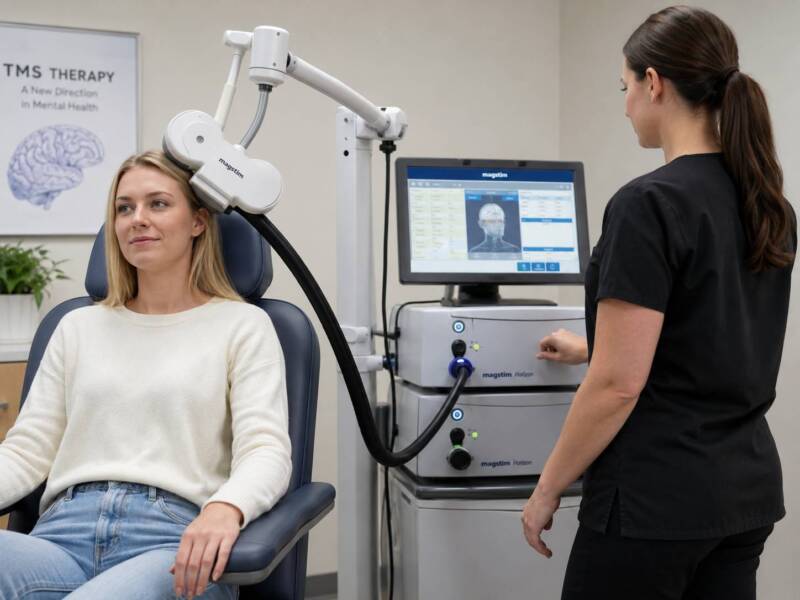
TMS is a noninvasive treatment that uses rapidly changing magnetic fields to stimulate neural circuits involved in mood regulation.
During treatment, an electromagnetic coil is placed against the scalp. Magnetic pulses pass through the skull and influence activity in targeted areas of the brain, commonly regions of the prefrontal cortex associated with depression.
There are no implanted electrodes and, unlike electroconvulsive therapy, standard TMS does not require general anesthesia.
The U.S. Food and Drug Administration first cleared an rTMS device for depression in 2008. Since then, the technology and treatment protocols have continued to evolve.
According to the National Institute of Mental Health, strong clinical evidence now supports rTMS for reducing depressive symptoms, particularly in people with moderate-to-severe depression who have not responded adequately to medication.
A conventional course might involve treatment five days a week for approximately four to six weeks.
That commitment has historically been one of the biggest drawbacks of TMS—but newer accelerated approaches are changing the equation.
2. Accelerated TMS Could Make Treatment Much Faster
One of the most interesting developments in depression technology is accelerated TMS.
Instead of having one session per day for several weeks, accelerated protocols can deliver multiple carefully spaced stimulation sessions during the same day.
That can potentially compress weeks of therapy into a much shorter period.
NIMH now notes that rapid-acting forms of rTMS have been cleared for treatment-resistant depression and that accelerated protocols can dramatically shorten the overall treatment course.
One well-known example of this new direction is personalized accelerated neuromodulation, in which MRI or other brain-imaging data may help doctors identify the most appropriate stimulation target for an individual patient.
The broader goal is simple: instead of giving everyone essentially the same stimulation protocol, clinicians want to determine which brain circuit should be targeted in which patient—and how intensely.
That represents an important shift toward personalized psychiatry.
Researchers are also investigating whether stimulating surface brain regions connected to deeper structures involved in depression can produce better results. NIMH highlighted research in 2024 examining connections with the subgenual anterior cingulate cortex, an area strongly associated with depression.
3. At-Home Brain Stimulation Is Becoming a Real Treatment Category
Perhaps the biggest change since older articles about technological depression treatments were published is the arrival of more serious at-home brain-stimulation technology.
One example is the Flow FL-100.
The FDA approved the Flow FL-100 in December 2025 for adults with moderate-to-severe major depressive disorder who are not considered treatment-refractory to medication. The device can be used as a standalone treatment or alongside another treatment.
This development matters because brain stimulation has traditionally meant traveling repeatedly to a specialized clinic.
Portable systems could potentially make treatment much easier to integrate into everyday life.
Another technology, the Proliv Rx System, received FDA approval in December 2025.
Rather than relying on conventional TMS, Proliv provides focal external combined occipital and trigeminal afferent stimulation. It is intended as an adjunctive treatment for adults with major depressive disorder who have not achieved satisfactory improvement after at least one antidepressant medication.
Importantly, the prescription-only system is designed for use either at home or in a clinic.
This doesn’t mean consumer brain-stimulation gadgets should suddenly be viewed as interchangeable with medical devices.
They aren’t.
Medical depression devices have specific indications, protocols, contraindications, clinical evidence, and regulatory oversight. Anyone considering this category should discuss it with a qualified healthcare professional rather than buying an unverified device online.
Still, the direction is significant: neuromodulation is starting to move beyond the clinic.
4. Prescription Digital Therapeutics Turn the Smartphone Into Part of Treatment
Not every technological treatment for depression involves sending energy into the brain.
Software itself is becoming a medical intervention.
In 2024, the FDA cleared Rejoyn, a prescription digital therapeutic designed to help reduce symptoms of major depressive disorder.
Rejoyn is a six-week smartphone-based program that combines cognitive-emotional training exercises with therapeutic lessons. It is intended as an adjunct to clinician-managed outpatient care for adults aged 22 and older who are taking antidepressant medication.
That’s an important distinction.
A prescription digital therapeutic isn’t simply a meditation app or a mood tracker. It is software developed for a specific medical purpose and evaluated through a regulatory process.
Digital treatments could have several advantages.
They can be available at home, provide structured exercises between medical appointments, collect information over time and potentially make certain forms of care easier to access.
But digital therapeutics should generally be thought of as another tool in the treatment ecosystem, not a replacement for psychiatrists, psychologists, medications or emergency mental-health services.
5. Electroconvulsive Therapy Is Old Technology—but Still Highly Relevant
Electroconvulsive therapy, or ECT, might sound out of place in an article about new technology.
In reality, it remains one of the most important technology-based treatments for severe depression.
Modern ECT is very different from its often-negative portrayal in popular culture.
Treatment is performed under general anesthesia. Controlled electrical stimulation produces a brief seizure, creating changes in brain activity that can rapidly improve severe depressive symptoms.
NIMH describes ECT as one of the most widely used brain-stimulation therapies and notes that it can begin working considerably faster than antidepressant medication.
It may be considered particularly when depression is extremely severe, treatment-resistant or requires a rapid clinical response.
The major limitation is its potential side effects, particularly temporary confusion and memory difficulties.
Researchers are therefore studying technologies that might reproduce some of ECT’s benefits while reducing cognitive side effects.
One example is magnetic seizure therapy, or MST.
Rather than inducing a therapeutic seizure using electrical current, MST uses magnetic stimulation. Research has produced promising results, but the therapy remains experimental for depression.
6. Vagus Nerve Stimulation Offers Another Way to Influence Brain Networks
The brain doesn’t operate in isolation.
One increasingly important area of neuromodulation involves the vagus nerve, a major communication pathway connecting the brain with organs throughout the body.
Vagus nerve stimulation, or VNS, traditionally involves surgically implanting a pulse generator in the chest and connecting it to the vagus nerve.
The FDA approved implanted VNS for certain adults with severe chronic or recurrent depression who have not adequately responded to multiple previous antidepressant treatments.
It is not usually an early treatment option.
Researchers are also investigating transcutaneous vagus nerve stimulation, or tVNS, which attempts to stimulate the nerve through the skin without surgery.
That could eventually make vagus nerve stimulation substantially simpler and more accessible.
However, NIMH currently describes noninvasive tVNS for depression as experimental, so it’s important not to confuse promising research with an established depression treatment.
7. Deep Brain Stimulation May Be the Frontier of Precision Psychiatry
At the more experimental end of depression technology is deep brain stimulation, or DBS.
DBS requires neurosurgery.
Doctors implant electrodes into carefully selected areas of the brain. A connected device then delivers electrical pulses intended to modify activity within neural circuits associated with symptoms.
The technology is already used for certain neurological conditions and has also been investigated extensively in psychiatry.
For depression, however, DBS remains experimental.
NIMH notes that the technology has shown favorable results in research involving treatment-resistant depression but emphasizes that more high-quality evidence is required before conclusions can be drawn about its effectiveness.
What makes DBS particularly interesting isn’t necessarily that millions of people will soon receive brain implants.
Rather, DBS research is helping scientists understand depression as a disorder involving networks and circuits, rather than simply a shortage or excess of one particular brain chemical.
That insight could influence much less invasive treatments in the future.
Is Technology Replacing Antidepressants and Therapy?
Probably not—and that isn’t really the goal.
Depression is complex, and no single treatment works for everybody.
Psychotherapy and medication remain central components of depression care. NIMH states that treatment typically involves psychotherapy, medication or both, with brain-stimulation therapies becoming an option when those approaches do not sufficiently reduce symptoms.
What technology is doing is expanding the number of options.
A future treatment plan might involve antidepressant medication plus psychotherapy, for example, followed by TMS when symptoms remain resistant.
Another person might use a prescription digital therapeutic alongside medication.
Someone with severe treatment-resistant depression might eventually receive a highly personalized neuromodulation protocol based partly on their individual brain connectivity.
The future is therefore more likely to be combined and personalized treatment, rather than technology replacing conventional psychiatry.
What Is the Most Promising New Technology for Depression?
There isn’t one universal winner.
TMS currently has one of the strongest combinations of clinical evidence, real-world use and noninvasiveness.
Accelerated and personalized TMS could make it even more attractive by reducing treatment time and improving targeting.
At-home prescription brain-stimulation devices may be one of the most important emerging categories because they could dramatically change how and where neuromodulation is delivered.
Prescription digital therapeutics offer another promising direction, particularly because software can potentially be distributed much more widely than specialized medical equipment.
And deeper forms of neuromodulation—including VNS and experimental DBS—continue to provide valuable options and research insights for the hardest-to-treat cases.
The Future of Depression Treatment Is Becoming More Personalized
Perhaps the most important technological change isn’t a particular machine.
It’s personalization.
Historically, depression treatment has involved a considerable amount of trial and error. A patient may try one medication, wait several weeks, switch doses, try another medication, add psychotherapy and continue adjusting treatment until something works.
Researchers increasingly want to reduce that uncertainty.
Brain imaging, machine learning, digital symptom tracking and neurophysiological measurements could eventually help clinicians determine which treatment is most likely to work before months of trial and error.
NIMH is actively supporting the development of newer neuromodulation devices and associated software and hardware designed to improve how brain-stimulation treatments are delivered.
That doesn’t mean an AI scan will suddenly diagnose depression and select the perfect treatment.
The science isn’t there yet.
But psychiatry is clearly moving toward an era in which treatment decisions may incorporate much more information about the individual patient.
Final Thoughts
Technology for depression treatment has moved far beyond a futuristic idea.
TMS is already an established clinical treatment. Faster TMS protocols are reducing treatment times. Prescription digital therapeutics have reached smartphones. Newer prescription brain-stimulation devices are bringing neuromodulation into the home. Meanwhile, researchers continue exploring techniques such as noninvasive vagus nerve stimulation, magnetic seizure therapy and deep brain stimulation.
The most exciting part may not be any single device.
It is that people who do not improve with traditional treatment are gradually gaining more options.
At the same time, new does not automatically mean better. Different technologies have very different levels of evidence, regulatory authorization, risks and appropriate uses.
Anyone experiencing depression should discuss treatment choices with a qualified healthcare professional rather than attempting to select a brain-stimulation or digital treatment based solely on information online.
For people living with depression, however, the broader trend is encouraging: treatment is becoming faster, more targeted, more accessible and increasingly personalized.
This article is for informational purposes only and is not a substitute for professional medical advice, diagnosis or treatment.

TechnologyHQ is a platform about business insights, tech, 4IR, digital transformation, AI, Blockchain, Cybersecurity, and social media for businesses.
We manage social media groups with more than 200,000 members with almost 100% engagement.