





















The competition to build artificial intelligence infrastructure is entering a new phase, with technology companies increasingly developing their own processors rather than relying exclusively on conventional graphics processing units.
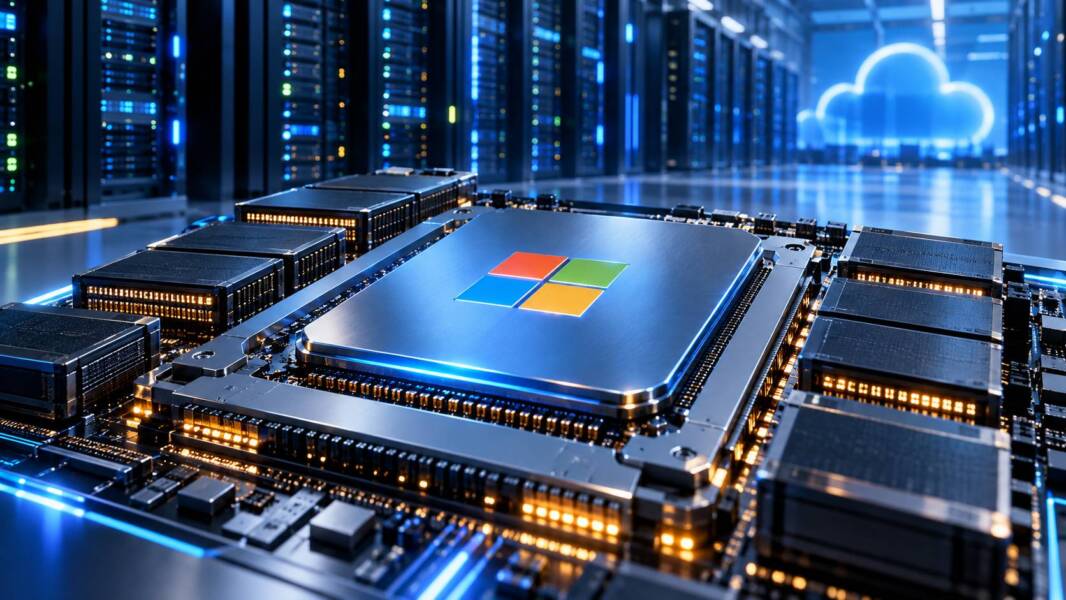
On October 12, 2026, Microsoft unveiled Maia 300, the third generation of its custom AI accelerator platform.
The new processor is designed specifically for AI inference: the computational work involved when a trained model generates answers, analyzes information, writes code or performs tasks.
Microsoft says Maia 300 will deliver approximately 40% more AI tokens per megawatt than leading GPU-based systems.
In a full rack containing 96 accelerators, the company also expects up to seven times the token throughput of its previous Maia 200 generation.
Production deployments are scheduled to begin in 2027.
Microsoft intends to expand the broader Azure Maia platform to multi-gigawatt deployments, making its custom accelerators the primary inference infrastructure for the company’s AI products and services.
The announcement represents a significant strategic move as Microsoft seeks greater control over the performance, energy consumption and economics of its expanding AI infrastructure. The Official Microsoft Blog
However, the performance comparisons come from Microsoft, and Maia 300 has not yet undergone independent production-scale evaluation.
The distinction matters when assessing its potential impact on the wider semiconductor industry.
What Is the Microsoft Maia 300 AI Chip?
The Microsoft Maia 300 AI chip is a specialized processor developed for running artificial intelligence models at large scale.
Unlike a general-purpose CPU, which handles a wide variety of computing tasks, an AI accelerator is optimized for the mathematical operations and data movement involved in neural-network processing.
Maia 300 is designed to operate inside Microsoft’s Azure data centers.
Its intended workloads include conversational AI, complex reasoning, long-context processing and multistep autonomous agents.
These applications increasingly require large amounts of memory bandwidth and computing capacity.
Microsoft’s design therefore focuses not only on raw processing power but also on the efficiency of the entire system.
That includes the processor, memory, networking, server rack and supporting software.
Microsoft Maia 300 Specifications
| Specification | Maia 300 |
|---|---|
| Architecture | Multi-chiplet AI accelerator |
| Primary workload | AI inference |
| Compute manufacturing process | TSMC N2P |
| Memory technology | HBM4 |
| Memory stacks | 8 |
| Memory capacity per accelerator | 288 GB |
| Peak memory bandwidth | 18 TB/s |
| Accelerator thermal design power | 950 W |
| Accelerators per rack | 96 |
| Rack power envelope | 167 kW |
| Total rack HBM capacity | 27.6 TB |
| Aggregate rack memory bandwidth | 1.7 PB/s |
| Maximum announced superpod | 12,288 accelerators |
| Planned production deployment | 2027 |
These specifications are drawn from Microsoft’s official announcement and architecture documentation. Microsoft Azure
The most important takeaway is that Maia 300 is not simply a faster individual chip.
It is part of a complete computing platform designed to increase the amount of useful AI work performed within a limited power budget.
Why Microsoft Is Building Its Own AI Chips
Microsoft operates some of the world’s largest cloud computing and artificial intelligence services.
Products such as Microsoft Copilot require substantial computing infrastructure to generate responses for users.
As adoption increases, the cost of running those services becomes increasingly important.
Traditionally, AI infrastructure has relied heavily on accelerators supplied by companies such as Nvidia and AMD.
These processors remain important across the AI industry.
However, companies operating enormous data centers have an incentive to develop hardware optimized for their own workloads.
The Economics of AI Inference
Training a large AI model can require substantial computing resources.
But training is only part of the economic equation.
Once deployed, a popular model may generate billions of responses.
Every interaction consumes computing time, electricity, memory bandwidth and data-center capacity.
A small improvement in efficiency can become financially significant when multiplied across millions of daily users.
For example, a system that generates more tokens using the same amount of electricity can potentially serve more requests without requiring a proportional increase in power capacity.
That does not automatically mean the company will reduce prices.
The financial benefit also depends on hardware costs, utilization, maintenance and the expense of operating the surrounding infrastructure.
Nevertheless, inference efficiency is becoming an important competitive advantage.
Why Custom Hardware Can Help
A general-purpose GPU must support a broad range of workloads.
A custom AI accelerator can concentrate on the operations most important to its intended applications.
Microsoft can also coordinate hardware development with the teams building its AI models and services.
This approach allows engineers to optimize memory organization, data movement and networking around actual production requirements.
The company says its previous Maia 200 accelerator is already serving production workloads, including Microsoft Copilot.
The new generation builds on that operational experience. The Official Microsoft Blog
Maia 300 Uses a New Chiplet Architecture
One of the most important technical changes is Maia 300’s move to a multi-chiplet design.
Instead of placing every major function on one large silicon die, the processor separates different functions into specialized components.
These include computing, memory-controller and input/output functions.
Microsoft uses TSMC’s N2P manufacturing process for the compute chiplets.
Reuters reports that other components use a less expensive 3-nanometer manufacturing process.
This allows different parts of the processor to use manufacturing technologies appropriate to their requirements. Reuters
What Are Chiplets?
A chiplet is a relatively small semiconductor die designed to operate alongside other dies within a larger package.
Chiplet architectures allow manufacturers to combine specialized components rather than building every function into one monolithic processor.
This can provide several advantages.
Computing functions may benefit from the most advanced manufacturing technology.
Other functions may not require the same transistor density.
Separating them can improve design flexibility and potentially reduce manufacturing costs.
However, chiplet designs also introduce challenges involving communication between dies, power delivery and packaging complexity.
The final result depends on how effectively those components operate together.
Why the 2-Nanometer Process Matters
Advanced semiconductor manufacturing processes can improve transistor density and energy efficiency.
TSMC’s N2P process is an enhanced member of its 2-nanometer technology family.
Microsoft selected it for Maia 300’s computing components because performance per watt is especially important for AI inference.
However, the term 2 nanometers should not be interpreted as a literal measurement of every transistor feature.
Modern semiconductor process names represent generations of manufacturing technology rather than one universal physical dimension.
The practical question is how the process contributes to the performance, efficiency and cost of the finished system.
HBM4 Memory Is Central to Maia 300
Another major improvement is the adoption of high-bandwidth memory technology.
Maia 300 uses eight HBM4 memory stacks.
Together, they provide 288 GB of memory capacity and up to 18 TB/s of peak bandwidth per accelerator.
Microsoft says this represents approximately 2.5 times the memory bandwidth of Maia 200.
Memory capacity also increases by about 33%. Microsoft Azure
Why Memory Bandwidth Matters for AI
AI models contain large collections of numerical parameters.
During inference, processors repeatedly access these parameters and other information required to generate outputs.
The speed at which data moves between memory and computing units can become a limiting factor.
A processor with substantial mathematical computing capability may still operate inefficiently if it spends too much time waiting for data.
High-bandwidth memory helps address this problem.
HBM uses stacked memory dies and wide interfaces to provide very high data-transfer rates.
For large AI models, this can be as important as raw computing performance.
What Is the KV Cache?
Many modern language models use a structure known as a key-value cache.
The KV cache stores information from previously processed tokens so the model does not need to repeat every calculation when generating subsequent tokens.
This improves efficiency.
However, the cache consumes memory.
Long conversations and large numbers of simultaneous users can therefore create significant memory requirements.
Microsoft says Maia 300 supports advanced low-precision formats, including enhanced MXFP4, to reduce memory consumption.
The goal is to support larger contexts and more concurrent sessions within the available memory and power budget.
These techniques can improve efficiency, although their practical effects depend on the model and workload.
Microsoft Claims 40% More AI Output per Megawatt
The headline performance claim is that Maia 300 can deliver approximately 40% more tokens per megawatt than leading GPU-based systems.
This metric is important because electricity has become a major constraint on data-center expansion.
A megawatt represents one million watts of electrical power.
If two systems operate within the same power budget, the system generating more useful AI output may offer better infrastructure efficiency.
However, Microsoft’s comparison requires careful interpretation.
What Does Tokens per Megawatt Mean?
A token is a unit of text or other model input and output.
Language models process information in tokens rather than treating every word as one indivisible unit.
Tokens per megawatt measures the amount of token-processing work performed relative to electrical power.
For large AI services, this can be a useful operating metric.
But it does not measure every aspect of performance.
Two systems may differ in response latency, model quality, supported context length or total ownership cost.
A higher token-throughput figure also does not necessarily mean an individual user receives a response 40% faster.
Why the Benchmark Needs Context
Microsoft has not publicly identified the exact GPU systems used for its headline comparison.
Reuters specifically noted that omission in its October 12 reporting. Reuters
Without a complete benchmark methodology, readers cannot independently determine how broadly the 40% advantage applies.
Results may vary according to model size, batch size, precision format and workload characteristics.
The claim should therefore be understood as a company-reported expectation rather than an independently established industry-wide performance ranking.
That does not make the result meaningless.
It means the comparison needs further validation when production deployments begin.
Why Microsoft Is Designing Entire AI Server Racks
Maia 300’s architecture extends beyond the individual accelerator.
Microsoft has designed complete racks containing 96 processors.
Each rack operates within a 167-kilowatt power envelope.
The system provides approximately 27.6 TB of aggregate HBM capacity and 1.7 PB/s of combined memory bandwidth.
These figures illustrate the scale of the platform.
However, the aggregate bandwidth is distributed across the accelerators.
It should not be interpreted as a single shared memory pool that every processor can access at full aggregate speed without communication overhead.
Seven Times the Previous Generation’s Throughput
Microsoft says a fully configured Maia 300 rack can deliver up to seven times the token throughput of Maia 200.
The company also reports more than 2.5 times the performance per watt.
These improvements reflect several changes, including greater accelerator density, higher memory bandwidth and architectural optimizations.
Importantly, the rack-level throughput improvement is not equivalent to claiming that one Maia 300 processor is seven times faster than one Maia 200 processor.
The comparison involves complete systems.
That distinction is essential when evaluating the announcement.
Liquid Cooling Becomes More Important
A 167-kilowatt rack produces a substantial amount of heat.
Removing that heat efficiently is essential for reliable operation.
Microsoft’s architecture documentation describes a hybrid cooling system.
Liquid cooling removes more than 80% of the rack’s thermal load, while air cooling handles supporting components.
The company has also designed the system to operate with different facility cooling arrangements.
This reflects a broader challenge facing AI data centers: computing density is increasing, and conventional air-cooling approaches may not be sufficient for every deployment. Microsoft Azure
Maia 300 Can Scale to More Than 12,000 Accelerators
Microsoft has also introduced a networking architecture designed to connect large groups of Maia processors.
The system uses a two-tier structure.
Individual racks contain 96 accelerators.
Up to 128 racks can be connected into a larger configuration that Microsoft calls a superpod.
At maximum announced scale, this creates a system containing 12,288 accelerators.
The architecture uses electrical connections within racks and optical networking between racks.
Microsoft says the design supports communication across the system through a unified programming model. Microsoft Azure
Why Networking Matters for AI
Large AI models often require more computing resources than a single accelerator can provide.
The workload must therefore be distributed across multiple processors.
Those processors need to exchange information efficiently.
If communication becomes slow, the additional computing capacity may not translate into proportional performance improvements.
This is particularly important for large reasoning models and AI agents that perform complex, multistep operations.
Microsoft’s networking approach is intended to reduce communication overhead and improve accelerator utilization.
However, actual performance will depend on workload placement, communication patterns and software optimization.
Will Maia 300 Replace Nvidia GPUs?
Microsoft’s announcement increases competitive pressure on established AI accelerator suppliers.
But it would be premature to conclude that Maia 300 will replace Nvidia GPUs throughout the industry.
The new processor is designed primarily for Microsoft’s own infrastructure.
Nvidia offers a broader ecosystem that includes GPUs, networking equipment, software libraries and developer tools.
That ecosystem remains important to organizations running diverse AI and scientific workloads.
Different Products Serve Different Requirements
Custom inference accelerators can be attractive for large cloud providers operating predictable workloads at enormous scale.
General-purpose GPUs offer flexibility across training, inference, scientific computing and other applications.
Microsoft’s strategy does not require every workload to move to Maia.
The company continues to describe its AI infrastructure as heterogeneous, meaning it can use different processors and models according to their requirements.
The more realistic near-term consequence is a broader range of hardware options.
Why Competition Could Matter
Greater competition may encourage improvements in energy efficiency, pricing and performance.
It could also reduce dependence on individual hardware suppliers.
However, developing custom chips is expensive and technically difficult.
A company must invest in semiconductor design, software, manufacturing relationships and infrastructure.
Those costs can be justified more easily when the company operates AI services at very large scale.
This helps explain why custom AI accelerators are especially attractive to major cloud providers.
What Maia 300 Means for Microsoft Copilot and Azure
Microsoft plans to use Maia 300 across its AI products and services.
Potential applications include Microsoft Copilot, GitHub Copilot, Microsoft Foundry and internally developed AI models.
The new platform is designed for workloads involving long contexts, interactive responses and sustained agent activity.
For example, a coding assistant may need to analyze a large repository while maintaining context across several steps.
An enterprise AI agent may need to retrieve information, reason through a task and coordinate multiple operations.
These workloads create different demands from simple text generation.
Will Users Notice Faster AI Responses?
Possibly, but faster responses are not guaranteed.
Improved infrastructure efficiency can allow a service provider to support more users or more complex workloads.
It may also reduce operating costs.
Whether users experience lower latency depends on the entire service, including networking, model architecture, scheduling and software performance.
Microsoft has not announced a universal percentage improvement in response speed for Copilot users.
Will Azure AI Become Cheaper?
The announcement does not establish future Azure pricing.
Lower operating costs could create room for more competitive pricing, but that is a business decision.
Cloud-service prices depend on numerous factors beyond processor efficiency.
Organizations should therefore evaluate actual service prices and performance rather than assuming that a new chip automatically produces cheaper AI subscriptions.
What We Know About the 2027 Rollout
Microsoft says Maia 300 will begin production deployments in 2027.
The company also plans to expand its Maia infrastructure to multi-gigawatt scale.
Reuters reported that Microsoft could deploy more than one million Maia 300 chips next year.
However, that figure represents a potential deployment scale rather than a confirmed number of installed and operational processors. Reuters
The distinction is important.
A successful rollout depends on semiconductor manufacturing, memory supply, packaging, server production, networking and data-center readiness.
Power availability and cooling infrastructure can also affect deployment schedules.
What Remains Unconfirmed?
Several important details are not yet established.
Microsoft has not provided a complete independent benchmark comparison against named competing GPU systems.
The company has also not announced a generally available hourly rental offering for Maia 300.
Nor has it established that every Azure AI service will move to the new hardware immediately.
The announced production timeline is therefore a significant milestone, but it is not proof of completed large-scale deployment.
The Bigger Picture: AI Efficiency Is Becoming a Strategic Priority
The Maia 300 announcement reflects a change in how the AI industry measures progress.
For years, much of the discussion focused on model size and raw computing performance.
Those metrics remain important.
But as AI becomes embedded in everyday applications, the economics of running models become increasingly significant.
A system that generates more useful output per watt can improve the economics of AI services.
A system that moves data more efficiently may also reduce the need for additional infrastructure.
And a system designed around actual workloads may achieve advantages that are not obvious from individual chip specifications.
Microsoft’s approach combines all three ideas.
The company is attempting to optimize the entire AI infrastructure stack, from semiconductor design to application deployment.
Whether Maia 300 delivers its promised advantages will become clearer when independent production-scale results are available.
Frequently Asked Questions
What is Microsoft Maia 300?
Maia 300 is Microsoft’s third-generation custom AI accelerator, designed primarily for large-scale AI inference in Azure data centers.
When was Maia 300 announced?
Microsoft announced Maia 300 on October 12, 2026.
When will Maia 300 become available?
Microsoft plans to begin production deployments in 2027. It has not announced general availability as a standalone consumer product.
How much memory does Maia 300 have?
Each accelerator includes 288 GB of HBM4 memory, with peak bandwidth of 18 TB/s.
How much power does Maia 300 consume?
Microsoft specifies a 950-watt thermal design power for each accelerator. A complete rack containing 96 accelerators operates within a 167-kilowatt power envelope.
Is Maia 300 faster than Nvidia GPUs?
Microsoft expects approximately 40% more tokens per megawatt than leading GPU-based systems. However, it has not identified the exact comparison systems or published sufficient information for an independent universal performance ranking.
Is Maia 300 designed for AI training?
Its primary focus is inference, including reasoning, long-context processing and agentic workloads. Microsoft’s announcement does not position it as a universal replacement for training GPUs.
Will Maia 300 make ChatGPT or Copilot cheaper?
The announcement does not establish future subscription or API pricing. Improved infrastructure efficiency could influence operating costs, but customer pricing remains a separate decision.
Conclusion
The Microsoft Maia 300 AI chip represents an important development in the evolution of artificial intelligence infrastructure.
Rather than concentrating exclusively on raw computing power, Microsoft is emphasizing memory bandwidth, data movement, networking and energy efficiency.
The new accelerator combines advanced chiplet manufacturing, HBM4 memory and a rack-scale architecture designed to support demanding AI workloads.
Microsoft’s performance claims are ambitious.
The company expects approximately 40% more tokens per megawatt than leading GPU-based systems and up to seven times the rack-level throughput of its previous generation.
However, these results still require independent validation under real production conditions.
The planned 2027 rollout will provide a clearer picture of the platform’s practical capabilities.
For the broader technology industry, the announcement reinforces a significant trend: the future of AI infrastructure will depend not only on building more powerful processors, but also on making every watt of electricity and every unit of memory deliver more useful computing.
That competition could shape the cost and availability of artificial intelligence services for years to come.

TechnologyHQ is a platform about business insights, tech, 4IR, digital transformation, AI, Blockchain, Cybersecurity, and social media for businesses.
We manage social media groups with more than 200,000 members with almost 100% engagement.