


















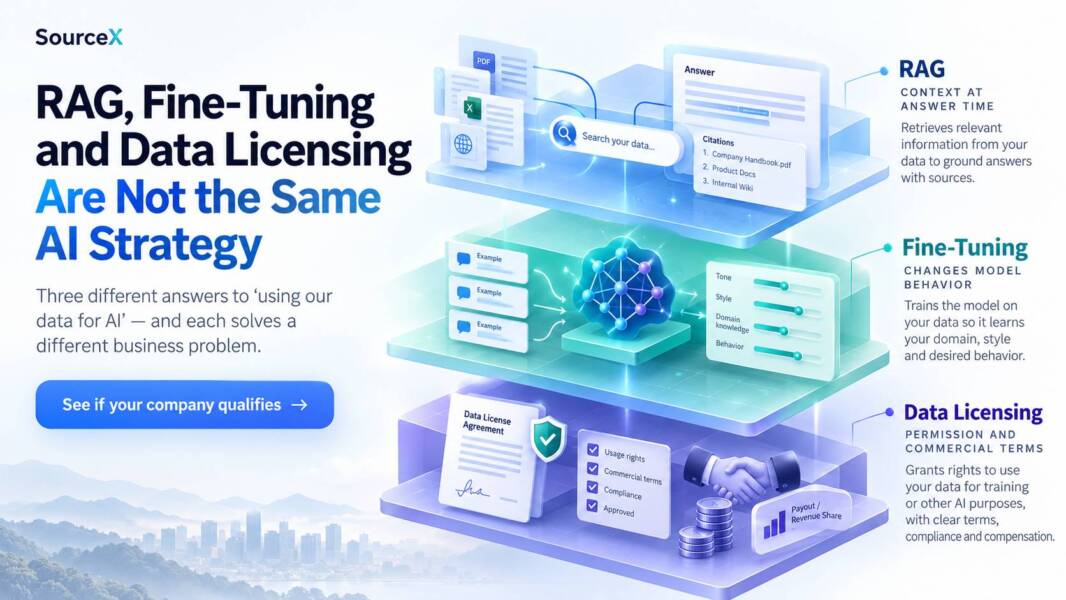
Boards often lump them together as “using our data for AI.” Each answers a different business question, and confusing them sends projects in the wrong direction.
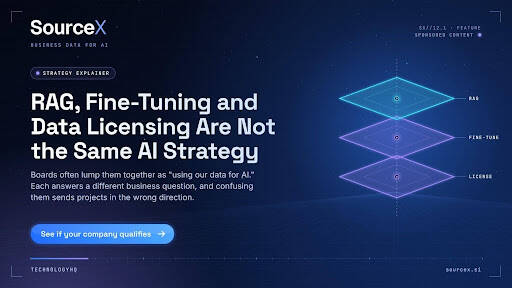
Illustration: three stacked planes for RAG, fine-tuning and licensing. Conceptual artwork for this sponsored article.
The board asks a reasonable question: “How are we using our data for AI?”
Three answers arrive at once. Connect a model to our internal documents. Train a model on our examples. License some of our records to someone else and get paid.
All three sound like versions of the same project. They are not. Retrieval-augmented generation, or RAG, supplies relevant context to a model at the moment it answers. Fine-tuning adjusts a model’s behavior using training examples. Data licensing grants another organization contractual permission to use defined material for agreed purposes.
A company can combine them. RAG and fine-tuning are technical approaches; licensing supplies contractual permission and commercial terms. A licensed dataset might support either approach or a separate evaluation. The useful comparison starts with the objective, rather than treating these as mutually exclusive options.
RAG starts with a question someone needs answered
An internal assistant might retrieve the current travel policy or an approved product spec before drafting a reply. The project needs an accessible source, the right permissions and a way to handle stale or conflicting content.
RAG can supply updated reference material without retraining the model’s parameters. RAG systems can also include trained retrievers or fine-tuned generators; retrieval and training are compatible. Its hard part is control: what the system can retrieve, what the model receives and whether this user is entitled to see it.
One thing RAG never establishes is a right to license the same source to anyone else.
Fine-tuning starts with a behavior to learn
A team might want a model to follow a house format, apply a task pattern or perform more consistently on one workflow. The training examples need to support that goal and stay separate from the material used to measure success.
A record that is easy to retrieve is not automatically a good training example. It may lack an outcome, contain an obsolete instruction or repeat what is already elsewhere. The useful question is always: what behavior should change, and how will we measure it?
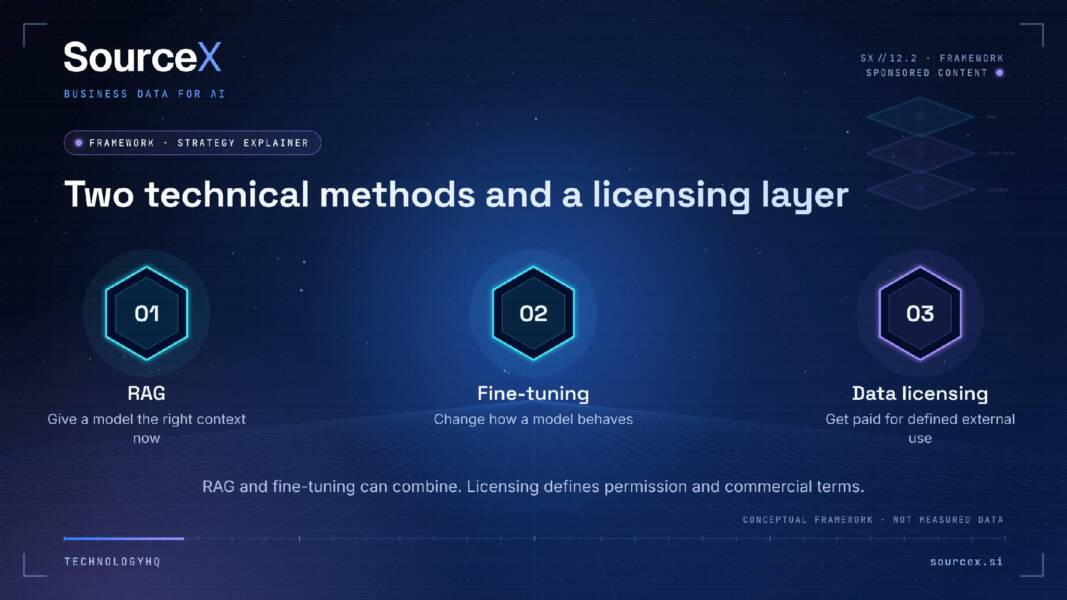
Two technical methods and a licensing layer. RAG and fine-tuning can combine, and either may use licensed material. Conceptual comparison, not a sequence of required steps.
Licensing starts with rights and a transaction
An external license has a completely different center of gravity. Which records are included? Who can grant the rights? Which uses, recipients, duration and restrictions are agreed? What preparation and acceptance conditions apply?
The supplier needs to understand those terms even though it keeps ownership of its original records. Retained ownership can sit alongside substantial rights granted to a counterparty and limits on future AI licensing of the same material.
Notice what licensing does not require: the supplier never has to build or fine-tune a model itself. It needs an authorized, suitable dataset and an acceptable deal.
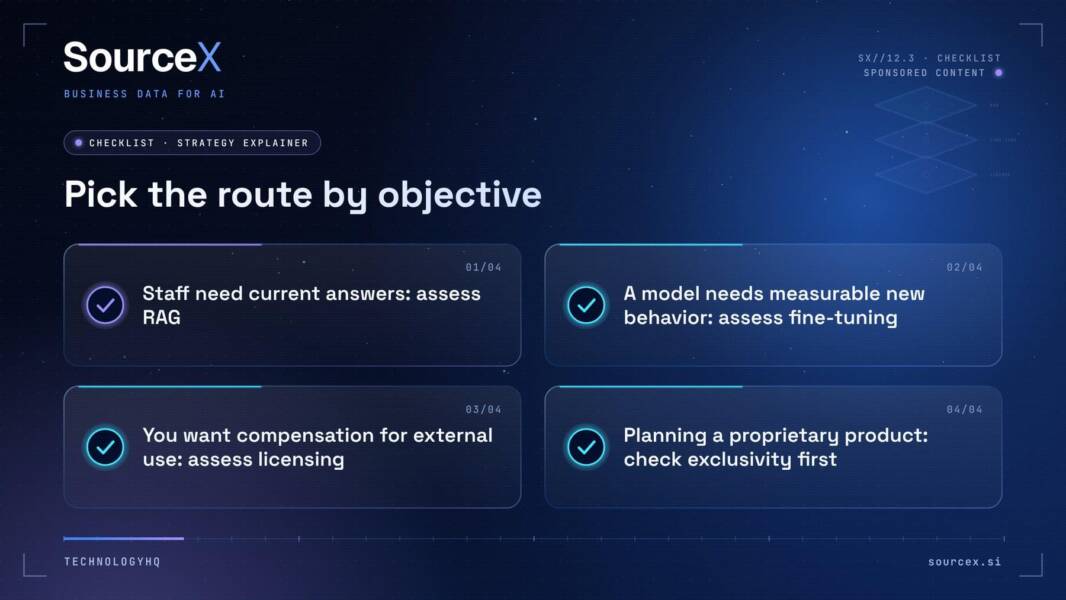
Pick the route by objective. Four review points from the article; the full text supplies the context and conditions.
One archive can support several authorized uses
Take a hypothetical service history. Current approved guidance might feed internal retrieval. Selected, well-formed cases might become training examples. A separate held-out collection might support evaluation. And an agreed subset, subject to permission and preparation, might be licensed externally.
The distinctions shape both design and economics. A company that plans to build a proprietary AI product should check whether an exclusive license would conflict with that plan before it signs, not after.
Write down the intended route before choosing a platform or forecasting revenue.
Where SourceX fits
SourceX is a direct licensing counterparty for approved business data used in AI training and evaluation. It manages qualification, the agreement, preparation and payout.
Its advertised payouts reach up to $4 million, the upper bound for the largest enterprise datasets. That is not a typical payment, a guarantee of acceptance or a suggestion that implementing RAG will produce licensing revenue.
Its fit check is a low-commitment way to explore one commercial route, and it is best weighed alongside the company’s internal AI plans and longer-term rights strategy.
Which route should a business consider first?
Begin with the objective. If staff need current answers, assess retrieval. If a model needs a measurable change in behavior, assess fine-tuning. If the company wants compensation for defined external use, assess licensing alongside the technical use the recipient intends. The choice gets much easier when every proposal answers the question it was actually built to solve.
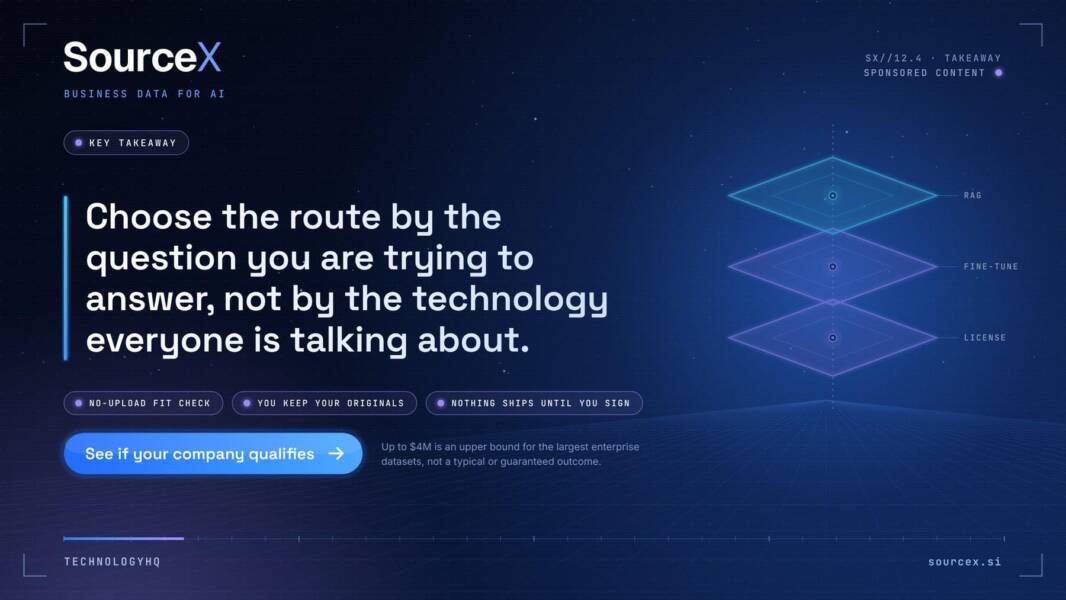
Key takeaway: Choose the route by the question you are trying to answer, not by the technology everyone is talking about.
If an external license fits the objective, check company fit with SourceX using a system-level inventory. Keep the intended use and your internal AI plans visible before agreeing to the rights.
About the founder
Noah Loul is a four-time founder and the founder and CEO of SourceX, which licenses business data directly from companies for AI training and evaluation. He previously founded B2B Rocket, acquired by Blackpearl Group. His work focuses on building permission-based data infrastructure for AI.

TechnologyHQ is a platform about business insights, tech, 4IR, digital transformation, AI, Blockchain, Cybersecurity, and social media for businesses.
We manage social media groups with more than 200,000 members with almost 100% engagement.