























An AMD AI supercomputer planned for Sweden could give European startups, researchers and businesses a new option for training and running advanced artificial intelligence models. On October 13, French cloud provider Scaleway announced that it would deploy a commercial AI computing system powered by AMD Instinct MI355X accelerators and the ROCm software stack. The company describes it as Europe’s first commercial AMD AI supercomputer. That is a claim about the intended commercial service, not the first use of AMD hardware in European supercomputing.
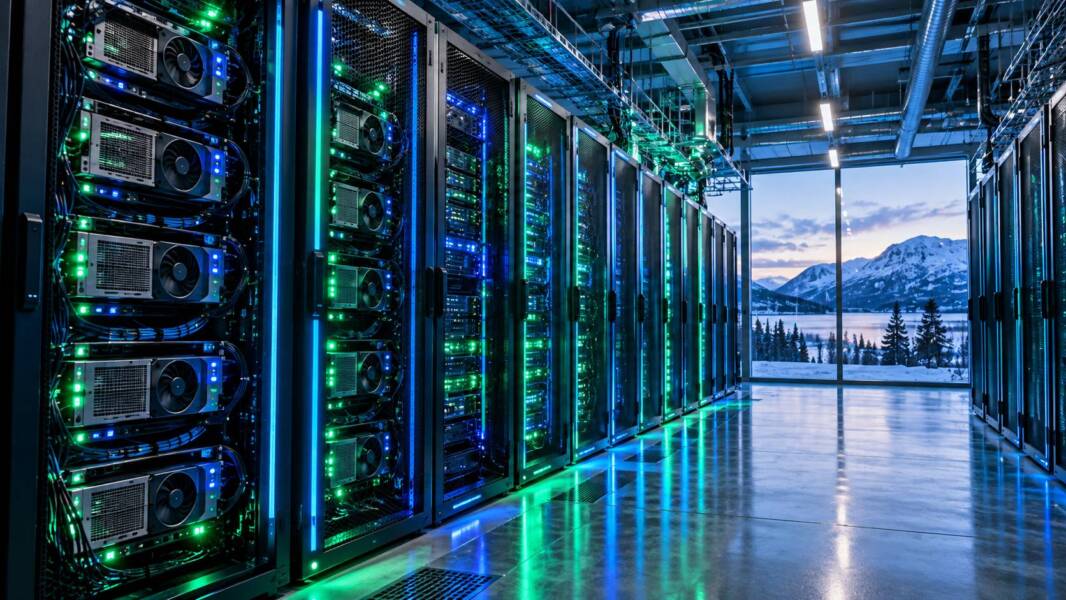
The announcement matters because AI infrastructure choices increasingly affect software compatibility, operational costs, data governance and dependence on individual hardware suppliers. But the project is still a planned deployment: Scaleway has not disclosed a public launch date, a final GPU count or rental prices for the Swedish system.
AMD AI Supercomputer: What Scaleway Announced
The Swedish installation will be Scaleway’s first supercomputer deployment outside France. Its intended customers include AI developers, startups and enterprises that need substantial computing capacity for model training or inference.
Scaleway selected AMD’s Instinct MI355X GPUs, rather than making the Swedish cluster another NVIDIA-based installation. It also confirmed that the system will use AMD ROCm, an open-source GPU computing platform. The company positioned the project as an expansion of hardware choice for customers building AI applications in Europe.
The announcement was made at ai-PULSE 2026 in Paris, alongside a broader expansion of Scaleway’s European cloud footprint. Importantly, an announcement of deployment does not mean that customers can already reserve production capacity. As of October 15, the company has not provided a general-availability date or a public price list for this particular system.
The companies building the cluster
The system brings together several infrastructure specialists. AMD is supplying the accelerator technology and software ecosystem. Bull will integrate and deploy the cluster, including installation and maintenance. Giga Computing will provide servers, HPE Networking the high-performance Ethernet fabric, VAST Data the storage platform and Motul a liquid-cooling fluid designed for dense computing equipment.
This division of responsibilities reflects how modern AI infrastructure works: GPU performance matters, but networking, data delivery, cooling and operational reliability can determine how efficiently an entire cluster runs.
AMD AI Supercomputer Hardware: Why MI355X Matters
The Instinct MI355X is part of AMD’s MI350 family and uses the fourth-generation CDNA architecture. AMD specifies 288 GB of HBM3E memory and up to 8 TB/s of theoretical memory bandwidth per GPU.
That large memory capacity is relevant to AI workloads. Models need space for weights, intermediate calculations and, during inference, information retained while generating responses. More GPU memory can make some large-model configurations easier to deploy, though the actual benefit depends on model architecture, precision and software efficiency.
AMD also advertises up to 10.1 petaflops of theoretical peak MXFP4 or MXFP6 matrix performance per MI355X. This is a hardware specification under particular low-precision conditions, not a measured throughput figure for Scaleway’s future cloud service.
Eight-GPU MI355X platforms can offer approximately 2.3 TB of aggregate HBM3E memory. But Scaleway has not specified how many such platforms will be installed in Sweden, so multiplying these figures into a total supercomputer performance claim would be speculative.
Training and inference have different needs
Training a large model involves repeatedly processing data, calculating gradients and updating parameters. It can require extensive communication among GPUs and substantial storage bandwidth.
Inference uses an already-trained model to generate predictions or responses. Depending on the application, important measures include time to first token, tokens generated per second, concurrency and cost per useful output.
The MI355X’s memory capacity and compute capabilities make it a plausible candidate for both categories. Still, no independent benchmark of the finished Swedish cluster has been published. Buyers should wait for measurements on the workloads they actually run.
AMD AI Supercomputer Software: ROCm vs. CUDA
The AMD AI supercomputer will run ROCm, AMD’s open-source software stack for GPU computing. ROCm provides drivers, compilers, runtimes and libraries used by AI and high-performance computing applications. Its ecosystem includes integrations with tools such as PyTorch and popular inference frameworks.
The dominant alternative is NVIDIA’s CUDA ecosystem, which has accumulated years of developer tools, optimized libraries and application support. CUDA is tightly tied to NVIDIA hardware, whereas ROCm gives organizations another route to accelerated computing.
This does not mean moving a CUDA-based application to ROCm is always effortless. Some frameworks provide portable interfaces, but custom kernels, dependencies and specialized optimizations can require changes. Even when software runs on both vendors’ GPUs, performance may differ substantially.
For teams considering the Swedish cluster, a realistic migration test should include model loading, distributed execution, custom operators, monitoring and recovery from failed jobs—not just a simple demonstration that a framework starts successfully.
What developers should test first
A small pilot should establish the exact ROCm, driver and framework versions supported by the service. Developers can then run representative training or inference jobs and compare them with their current provider.
Useful measurements include throughput, end-to-end latency, GPU utilization, memory pressure, failed jobs, engineering time and total cost. A lower advertised GPU-hour price, if one eventually appears, would not necessarily produce a lower cost per completed training run.
Is this Europe’s first AMD AI supercomputer?
Scaleway calls the Swedish project Europe’s first commercial AMD AI supercomputer. The qualification matters.
Europe already has AMD-powered supercomputing infrastructure. Finland’s LUMI system, for example, uses AMD technology for research-oriented high-performance computing. US-based cloud providers have also offered AMD GPU capacity to European customers.
The more specific claim is that Scaleway plans to make a dedicated AMD-based AI supercomputing service commercially available through a European cloud provider. That could expand procurement options, but it should not be described as the arrival of AMD computing in Europe for the first time.
It also remains a prospective service until deployment and customer access are confirmed.
Why Sweden Was Chosen for the AMD AI Supercomputer
Scaleway points to Sweden’s technology ecosystem, its existing local relationships and a largely low-carbon electricity mix. The company expanded its Swedish presence through a partnership with telecom operator Tele2 earlier in 2026.
The location could appeal to European organizations that want workloads hosted within the region and prefer to work with a European cloud operator. Geographic proximity can also help some applications with network latency and operational coordination.
However, Sweden’s electricity mix alone does not establish the environmental footprint of the new system. AI data centers consume energy during operation and embody emissions from hardware manufacturing and construction. Cooling design, utilization, power sourcing and equipment life all affect the result.
Scaleway has not published enough project-specific information to calculate the Swedish cluster’s power usage effectiveness, annual electricity demand or carbon footprint.
European hosting is not automatic GDPR compliance
For organizations processing personal or regulated data, the location of a data center is important—but not sufficient.
A responsible cloud assessment should also examine contractual terms, subprocessors, support access, encryption and key management, auditability, incident response and any international data transfers.
An EU-hosted GPU cluster may help satisfy a data-residency requirement. It does not automatically make every application compliant with GDPR or sector-specific rules.
Scaleway is also expanding with NVIDIA in Denmark
The Swedish announcement is only one part of Scaleway’s infrastructure strategy.
On the same day, the company announced plans for a new GPU Zone in Copenhagen using NVIDIA HGX B300 systems. This is a useful contrast: Scaleway is not abandoning NVIDIA in favor of AMD. It is planning to offer customers multiple accelerator architectures under a European cloud brand.
The wider expansion plan includes additional availability zones in Stockholm and Frankfurt in 2027. Scaleway also describes a longer-term ambition for infrastructure across Paris, Copenhagen and Stockholm totaling tens of thousands of GPUs.
Those are broader expansion ambitions, not confirmed specifications for the Swedish AMD supercomputer. The 2027 availability-zone timetable should not be assumed to be the launch date for the MI355X cluster.
For customers, the multi-vendor strategy may be more valuable than any single chip announcement. It creates the possibility of choosing hardware according to workload rather than being limited to one accelerator ecosystem.
What European AI sovereignty really means
The term AI sovereignty often appears in discussions of European cloud infrastructure. It can refer to several different objectives: keeping data in a chosen jurisdiction, using locally operated infrastructure, reducing dependence on foreign vendors or retaining control over software and models.
The Swedish project addresses some of these goals more directly than others. Scaleway is a European provider and plans to host the computing infrastructure in Sweden. But the accelerators are designed by US-based AMD, and the system incorporates components and technologies from multiple international suppliers.
This is not a contradiction. Full supply-chain independence is not a realistic description of most contemporary AI infrastructure. A more useful measure is whether customers gain meaningful choices about where workloads run, who operates the service and how easily applications can move elsewhere.
Open software can help with portability, but the ability to migrate also depends on data formats, application architecture, contracts, network services and proprietary tooling.
AMD AI Supercomputer: Launch Date, Cost and Open Questions
Several questions remain unanswered in the official announcements.
Launch date: Scaleway has announced the deployment but has not published a firm date when general customers can begin using the Swedish MI355X capacity.
GPU count: The company has not disclosed the exact number of accelerators in this cluster.
Pricing: No public GPU-hour rates, reserved-capacity terms or storage and networking charges have been specified for the new system.
Benchmarks: There are no independently verified training or inference performance results for the completed installation.
Service details: The announcement does not fully define the customer-facing configuration, scheduling options, service-level commitments or available software images.
These gaps are not unusual for an infrastructure project at the announcement stage. They do mean that customers cannot yet make a reliable total-cost comparison with an established cloud GPU service.
How Businesses Should Evaluate AMD AI Supercomputer Capacity
A company considering the AMD AI supercomputer should start with its workload rather than the hardware headline.
For model training, determine the number of accelerators required, memory needs, distributed communication requirements and expected job duration. For inference, measure the throughput and latency needed at realistic request volumes.
Next, validate software portability. Teams with existing CUDA-specific code should estimate migration effort and test their critical dependencies. Organizations already using portable frameworks may face fewer obstacles, but they should still benchmark the actual model and configuration.
Finally, compare total cost and operational requirements. GPU rental is only one part of the equation. Data transfer, storage, reserved capacity, support, reliability and developer time can materially change the outcome.
A procurement decision should wait for published service terms and a production-ready test environment.
Frequently asked questions
What is Scaleway building in Sweden?
Scaleway has announced a commercial AI supercomputer powered by AMD Instinct MI355X GPUs and the ROCm software ecosystem. It will be the company’s first supercomputer deployment outside France.
Is the AMD AI supercomputer available now?
The project was announced on October 13, 2026. Scaleway has not confirmed a public general-availability date for the Swedish system.
Which AMD GPU will it use?
The planned installation uses AMD Instinct MI355X accelerators. AMD lists 288 GB of HBM3E memory and up to 8 TB/s of theoretical memory bandwidth per GPU.
Is ROCm the same as CUDA?
No. Both support GPU computing, but ROCm is AMD’s open-source ecosystem and CUDA is NVIDIA’s proprietary platform. Application compatibility and performance depend on the software stack.
Will the Swedish service be cheaper than NVIDIA cloud GPUs?
There is not enough information to know. Scaleway has not announced pricing for the new installation, and a meaningful comparison requires workload-specific performance and total operating costs.
Does this mean Europe no longer depends on US AI hardware?
No. The project expands European-hosted compute options, but the accelerators and other infrastructure components still come from international technology suppliers.
Conclusion: More choice, with important details still pending
Scaleway’s AMD AI supercomputer is a notable development in European AI infrastructure because it combines a European cloud operator, a Swedish deployment and an alternative to the dominant NVIDIA software-and-hardware stack.
The potential benefit is not that one GPU vendor has definitively beaten another. It is that European organizations may gain another credible way to train and run AI models while choosing where their computing workloads are hosted.
The announcement is also a reminder to distinguish infrastructure plans from available services. Until Scaleway publishes capacity, pricing, launch timing and measured performance, the commercial value remains a proposition to test rather than a result to assume.
For developers and businesses, the right next step is to prepare portable workloads and evaluation criteria—then compare the Swedish service on evidence when access becomes available.

TechnologyHQ is a platform about business insights, tech, 4IR, digital transformation, AI, Blockchain, Cybersecurity, and social media for businesses.
We manage social media groups with more than 200,000 members with almost 100% engagement.