






















If it feels like hailstorms have become more violent in recent years, you are not imagining the headlines.
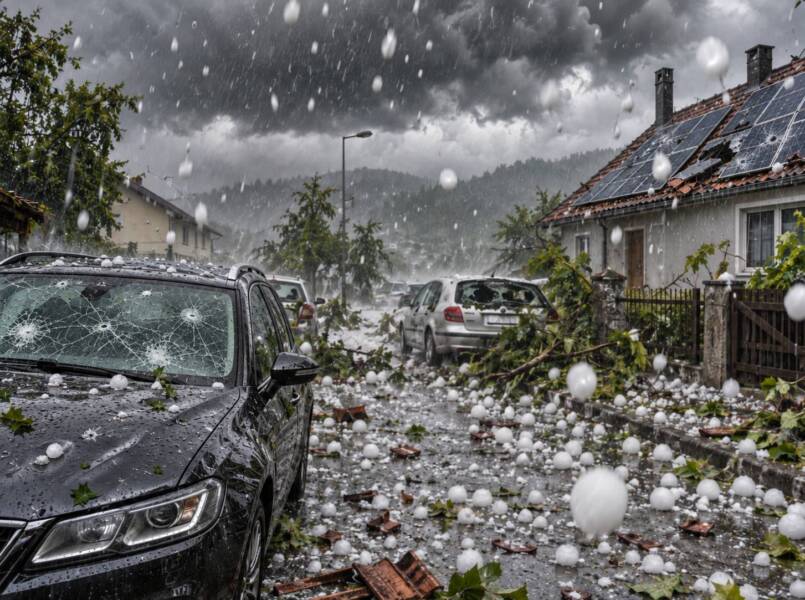
Cars with shattered windshields, solar panels destroyed in minutes, roofs punched through by ice and photos of hailstones nearly the size of grapefruits have become surprisingly common on social media and in weather reports.
But is hail really getting bigger?
And are hailstorms becoming more frequent around the world?
The answer is more complicated—and more interesting—than simply saying that global warming creates more hail.
Some regions are experiencing more very large hail, while others may actually see fewer hailstorms. At the same time, new research suggests that climate change is shifting the odds toward larger and potentially more destructive hailstones in many parts of the world.
Here is what scientists currently understand about why hail may be getting bigger, what we could expect in the coming decades and how new technology could help us prepare.
First, How Does Hail Actually Form?
Hail begins inside powerful thunderstorms.
These storms contain strong columns of rising air known as updrafts. When an updraft is powerful enough, it carries water droplets high into the atmosphere where temperatures are below freezing.
The droplets freeze.
Instead of immediately falling to the ground, however, they can remain suspended inside the storm.
As the frozen particle moves through areas containing supercooled liquid water, additional water freezes onto it. Layer after layer can accumulate around the original piece of ice.
The result is a hailstone.
Eventually, one of two things happens.
Either the hailstone becomes too heavy for the updraft to support, or the updraft weakens.
Gravity wins, and the hailstone falls toward the ground.
That means the size of hail depends heavily on what is happening inside the thunderstorm.
And this is where a warming climate becomes important.
Why Are Hailstones Getting Bigger?
There is no single cause.
Instead, several atmospheric changes can work together to create conditions favorable for larger hail.
One of the most important is the increasing amount of energy available to thunderstorms.
Warm air can contain more water vapor than cold air. As temperatures rise, the lower atmosphere can therefore become both warmer and, in many regions, more humid.
That combination can increase atmospheric instability.
Meteorologists often describe this using a measurement known as Convective Available Potential Energy, or CAPE.
You do not need to remember the acronym.
The important idea is simple: more atmospheric instability can help thunderstorms develop stronger updrafts.
And stronger updrafts can keep larger pieces of ice suspended inside a thunderstorm.
Instead of falling out when they are relatively small, hailstones may remain inside the cloud longer, collecting additional supercooled water and continuing to grow.
That creates the potential for much larger hail.
Recent research published in Nature in 2026 found that warming and changes in low-level atmospheric moisture could shift global hailstone distributions toward larger sizes.
But There Is a Catch: Warmer Air Also Melts Hail
This is where hail and climate change become particularly interesting.
A warmer atmosphere does not automatically mean larger hail reaches the surface.
Quite the opposite can happen.
As the climate warms, the altitude at which temperatures reach 0°C generally moves higher.
Scientists call this the freezing level or melting level.
A hailstone falling from a thunderstorm therefore has to travel through a deeper layer of warm air before reaching the ground.
Small hailstones can partially or completely melt during that journey.
This creates a strange situation.
Climate change can simultaneously make conditions inside some thunderstorms more favorable for growing very large hail while making it harder for small hail to survive the trip to the surface.
The result may be less small hail but more large hail in certain regions.
So when people ask, “Will climate change create more hail?” the better question may be:
Will climate change create more damaging hail?
In many regions, scientists increasingly believe the answer could be yes.
New Research Suggests Global Hail Damage Could Increase
One of the most important developments in hail research came in 2026.
A global study published in Nature estimated how hailstone sizes and hail-related damage potential could change later this century.
The researchers found a projected 36.5% to 42.1% increase in global hailstorm damage potential, depending on the emissions scenario.
Even more striking, the modeled frequency of hailstones measuring at least 30 millimeters increased by roughly 38% to 52%, while smaller hailstones became less frequent.
That does not mean every town on Earth will experience 50% more hail.
Climate systems do not behave uniformly.
Instead, the research indicates an overall shift toward more damaging hail sizes, with very large differences from one region to another.
Is Hail Increasing Everywhere in the World?
No.
This is one of the most important points to understand.
There is currently no evidence showing that hail frequency is simply increasing everywhere on Earth.
A major global study of hailstones larger than 5 centimeters, covering conditions between 1950 and 2023, found sharply different regional trends.
Europe showed the clearest widespread increase in very large hail.
Parts of the Southern Hemisphere, meanwhile, showed decreasing trends.
Researchers identified northern Argentina and surrounding parts of South America as some of the world’s most hail-prone areas, together with regions such as the U.S. Great Plains and South Africa. But the long-term direction of change was not the same everywhere.
In other words, global warming is changing the ingredients that produce hailstorms—but those ingredients interact differently depending on geography, humidity, winds and storm structure.
That is why the scientifically accurate conclusion is not:
“Climate change is causing more hail everywhere.”
It is:
Climate change appears to be changing where hail occurs, how large hailstones can become and how damaging hailstorms may be.
Why Europe Has Become a Major Hail Hotspot
Europe is especially interesting.
Recent global analysis found that Europe experienced one of the strongest widespread increases in very large hail events.
One of the most significant areas was northern Italy.
Researchers have linked this increase partly to greater low-level moisture and increased atmospheric instability—two ingredients capable of supporting powerful thunderstorms.
Italy has already experienced a remarkable example.
During the extreme storms of July 2023, a hailstone measuring approximately 19 centimeters was recorded in northern Italy.
Events such as this do not prove climate change by themselves. Individual storms have always been capable of producing exceptional hail.
What matters scientifically is whether the atmospheric conditions that favor these events are becoming more common.
Recent research suggests that, in parts of Europe, they are.
Why More Moisture Can Mean Bigger Hail
Temperature receives most of the attention in discussions about climate change, but moisture is just as important for severe thunderstorms.
A warmer atmosphere can generally hold more water vapor.
More moisture means storms may have access to a larger supply of water.
Inside a powerful thunderstorm, some of that water remains liquid even when temperatures fall below freezing. This is known as supercooled water.
When a hailstone collides with these droplets, the water freezes onto its surface.
The more supercooled water available—and the longer the hailstone remains inside a favorable updraft—the more opportunity it has to grow.
Recent detailed hail-trajectory and cloud simulations have suggested that increased cloud water can, under some conditions, more than compensate for additional melting caused by warmer temperatures.
However, researchers also emphasize another major uncertainty:
The structure and strength of the thunderstorm itself matter enormously.
Stronger Updrafts Can Produce Monster Hail
Think of a thunderstorm updraft as an enormous atmospheric elevator.
A weak elevator cannot carry something heavy.
A strong one can.
The same principle applies to hail.
Small hailstones can be suspended by relatively modest upward-moving air.
But keeping a 5-centimeter or 10-centimeter hailstone inside a cloud requires an extremely powerful updraft.
The most violent thunderstorms—particularly supercells—can contain rising air strong enough to support very large hailstones while they continue accumulating ice.
Climate change may create environments with greater instability that favor these intense updrafts in some regions.
But scientists are still studying exactly how thunderstorm organization, vertical wind shear, humidity and updraft width will change.
That is one reason future hail projections remain more uncertain than temperature projections.
Why We Seem to Hear About Giant Hail More Often
Climate is only part of the story.
Technology has dramatically changed how hail events are documented.
Twenty years ago, a giant hailstone might have fallen in a rural area and never been officially recorded.
Today, practically everyone carries a smartphone.
Photos and videos can appear online within minutes.
Weather radar has improved.
Hail-reporting networks have expanded.
Social media spreads spectacular weather images around the world almost instantly.
So part of the apparent increase in hailstorms comes from the fact that we are simply much better at seeing and recording them.
But improved observation alone cannot explain all of the changes scientists are detecting.
Long-term climate analyses and atmospheric modeling indicate that genuine changes are also occurring in some regions.
Why Hail Damage Is Rising So Quickly
Another important distinction is the difference between hail frequency and hail damage.
Damage can increase even if the number of storms stays unchanged.
Imagine the same hailstorm crossing farmland in 1970 and crossing a modern suburb today.
The modern storm might hit thousands of cars, expensive roofs, commercial buildings, greenhouses and large solar installations.
There is simply more property in harm’s way.
Construction costs have also increased, and vehicles contain increasingly expensive sensors, cameras, glass roofs and electronic components.
Therefore, rising insurance losses cannot automatically be blamed entirely on climate change.
Increasing population, urban development and infrastructure exposed to severe weather also play major roles.
Solar Panels Are Creating a New Hail Vulnerability
The rapid expansion of solar power adds another dimension to the problem.
Modern solar panels are designed to withstand normal weather and some hail impacts.
Extremely large hail is different.
A severe hailstorm can damage glass surfaces, create microscopic cracks in photovoltaic cells or destroy entire sections of a solar installation.
As solar farms expand into regions prone to severe thunderstorms, understanding future hail risk is becoming increasingly important for insurers, engineers and energy companies.
The same applies to homes.
Roofing standards that were adequate for historical hail conditions may need reconsideration in locations where extreme hail becomes more likely.
How Technology Can Help Us Prepare for Bigger Hailstorms
We cannot stop a supercell from forming or prevent giant hailstones from growing inside a thunderstorm.
But technology can dramatically change what happens before, during and after a hailstorm.
And this may become increasingly important as extreme hail becomes a greater threat in some regions.
AI Could Make Hail Forecasts Much More Accurate
Artificial intelligence and machine learning are becoming increasingly important in severe-weather forecasting.
Modern forecasting systems can process enormous amounts of information from radar, weather stations, satellites, lightning sensors and numerical weather models.
Machine-learning algorithms can then search for combinations of atmospheric conditions associated with severe hail.
NOAA’s National Severe Storms Laboratory, for example, is developing machine-learning systems capable of estimating both the probability of severe hail and the maximum hailstone size that a storm could produce. Experimental systems can generate predictions for windows ranging from around 30 minutes to several hours.
Instead of simply saying:
“A thunderstorm is approaching.”
future warning systems could increasingly provide much more specific information:
“There is a high probability of hail larger than 5 centimeters crossing this area within the next 40 minutes.”
That level of precision could give people valuable time to move cars under cover, protect equipment, close shutters or move indoors.
Advanced Radar Can See Inside a Hailstorm
Weather radar has already transformed our understanding of thunderstorms.
Modern dual-polarization radar sends and receives radar signals in two orientations, allowing meteorologists to distinguish more effectively between rain, snow and hail.
It can also provide clues about the size and concentration of hail inside a storm. NOAA’s hail research programs use these radar measurements together with specialized algorithms to identify hail and estimate its severity.
The next generation could be even faster.
Phased-array radar technology can scan storms much more rapidly than conventional systems. This matters because severe thunderstorms can evolve dramatically in only a few minutes.
Faster scans allow meteorologists to watch changes in the storm almost in real time rather than waiting for the next complete radar cycle.
NOAA is actively developing and testing rapid-scanning radar systems for severe weather, including hail-producing thunderstorms.
Combining Radar, Satellites and Lightning Data
Another major advance comes from combining several technologies instead of relying on a single weather instrument.
Systems can now integrate information from:
- multiple weather radars;
- satellites;
- surface weather stations;
- atmospheric observations;
- lightning-detection networks;
- computer forecast models.
NOAA’s Multi-Radar Multi-Sensor system, known as MRMS, already combines many of these information sources to help detect and analyze hazards including hail.
That approach gives meteorologists a much more complete picture of what is happening inside and around a storm.
As computing power improves, these systems should become faster and more detailed.
Smartphones Could Become an Important Part of Hail Protection
Better forecasting only helps if warnings reach people in time.
Smartphones make that possible on a massive scale.
Location-based severe-weather alerts could warn people in the exact path of a hailstorm rather than issuing a general warning covering an entire region.
Imagine receiving a notification saying:
“Large hail expected at your location in approximately 15 minutes. Move your vehicle under cover.”
For a homeowner, farmer or business, those few minutes could prevent thousands of dollars in damage.
Crowdsourcing can also improve the science.
When people report hailstone size and location through weather apps, researchers can compare observations from the ground with radar estimates.
NOAA researchers already use public reports from the mPING mobile application to improve and validate hail-detection algorithms.
In other words, smartphones are not only receiving weather information—they can also help improve it.
Smart Homes Could React Automatically
The next step may be automated protection.
A smart home receiving a severe-hail warning could potentially react before the storm arrives.
For example, connected systems could:
- automatically close exterior shutters;
- retract awnings;
- close skylight covers;
- warn the owner to move a vehicle;
- activate protective systems over vulnerable equipment;
- secure outdoor installations.
For commercial buildings and warehouses, automated hail warnings could trigger specific emergency procedures without waiting for someone to manually monitor the weather.
The combination of AI forecasting, Internet of Things sensors and automated building systems could therefore turn weather warnings into physical protection.
Cars Could Eventually Protect Themselves
Vehicles are among the most common victims of hailstorms.
Large hail can destroy windscreens, dent body panels and damage panoramic glass roofs in only a few minutes.
Connected vehicles already receive traffic, navigation and weather information.
It is easy to imagine future vehicles using highly localized severe-weather data to warn drivers that dangerous hail is approaching.
A navigation system might even suggest the closest parking garage or covered area.
Autonomous vehicles could potentially go further.
If severe hail were predicted, a self-driving vehicle might theoretically be able to relocate itself to protected parking before the storm arrives.
That technology is still developing, but it illustrates how weather forecasting and connected transportation could eventually work together.
Solar Farms Can Become Smarter
Solar energy is particularly exposed because photovoltaic panels are permanently outdoors.
Technology could help in several ways.
More accurate hail forecasts could allow solar farm operators to prepare before a severe storm arrives.
Some tracking solar installations can alter the angle of their panels. Depending on the system and storm conditions, changing panel orientation may help reduce the direct force of hail impacts.
At the same time, manufacturers are developing tougher glass, stronger frames and panel designs intended to tolerate more extreme impacts.
Future solar farms may combine:
hail-resistant modules + weather radar data + AI forecasts + automated panel positioning.
That would allow the installation to react to an approaching storm rather than simply endure it.
Drones Can Assess Damage After the Storm
Technology also has an important role once a hailstorm has passed.
Inspecting thousands of roofs or acres of solar panels manually can take days or weeks.
Drones equipped with high-resolution and thermal cameras can inspect large areas rapidly.
Computer-vision software can then analyze the images to identify potential damage.
For solar installations, thermal imaging can help detect damaged or malfunctioning modules that may not appear obviously broken from the ground.
Insurance companies can also use aerial imagery and satellite observations to map the path of a hailstorm and identify areas where damage is most likely.
This can make assessments faster after a major event.
Better Materials May Be Just as Important as Better Forecasts
Not every technological solution involves artificial intelligence.
Sometimes the best protection is simply building things differently.
Engineers can improve:
- impact-resistant roofing;
- reinforced windows;
- laminated automotive glass;
- stronger solar-panel glass;
- protective shutters;
- hail-resistant agricultural coverings.
If extreme hail becomes more common in a particular region, building codes could eventually evolve to reflect that changing risk.
This is similar to what already happens in areas exposed to earthquakes, hurricanes or heavy snow.
Homes and infrastructure can be designed around the hazards they are expected to face.
Technology Will Not Eliminate Hail—but It Can Reduce the Damage
No forecasting system will ever prevent hail from falling.
And even the most sophisticated AI model cannot predict the exact location of every giant hailstone.
Weather remains inherently complex.
But technology does not need to eliminate the hazard to make a huge difference.
If a warning arrives 20 minutes earlier, thousands of vehicles might be moved under cover.
If radar can identify a rapidly intensifying hail core sooner, communities can receive more targeted alerts.
If solar farms automatically react to an approaching storm, millions of dollars in equipment could potentially be protected.
And if buildings are designed using better information about future hail risk, damage can be reduced before the storm even forms.
The future of hail protection may therefore depend on a combination of:
better forecasting, faster radar, artificial intelligence, smarter infrastructure and stronger materials.
Could We Ever Stop Hail From Forming?
This question naturally follows from all of this.
If technology can predict hail, could humans simply prevent it?
For decades, different countries have experimented with techniques such as cloud seeding, often using substances intended to alter the formation of ice particles inside thunderstorms.
The idea is theoretically attractive: create many smaller ice particles instead of a smaller number of large hailstones.
But severe thunderstorms are enormous, chaotic systems containing extraordinary amounts of energy.
Proving that hail-suppression programs actually reduce damaging hail is extremely difficult because no two storms are identical. Scientists cannot simply run the same thunderstorm twice—once with cloud seeding and once without it—to compare the results.
For that reason, prediction and damage prevention remain much more reliable strategies than trying to control the storm itself.
So Will Hailstones Keep Getting Bigger?
Scientists cannot predict the size of every future hailstorm.
But the overall picture is becoming clearer.
A warming atmosphere changes several of the fundamental ingredients responsible for hail.
More heat and moisture can increase atmospheric instability.
Greater instability can support stronger thunderstorms and updrafts.
More cloud water can accelerate hailstone growth.
At the same time, higher freezing levels cause more melting as hail falls toward the surface.
Those competing effects may eliminate more small hail while allowing the largest hailstones produced by powerful storms to become an increasingly important threat.
The result will also vary dramatically by region.
Some areas may experience more large hail.
Others may experience fewer hail days.
And some could see relatively small changes.
The Bottom Line
So, why are hailstones getting bigger?
The best scientific answer is that climate change is altering the environment in which thunderstorms develop.
Warmer and sometimes more humid air can provide additional energy and water for powerful storms. Strong updrafts can keep hailstones suspended longer, allowing them to grow larger.
Meanwhile, a warmer layer below the storm melts smaller hailstones more efficiently.
Together, those processes can shift hail populations away from numerous smaller stones and toward a greater proportion of large, destructive hail in some parts of the world.
The trend is not uniform, and hail is not becoming more common everywhere.
But recent research increasingly points toward something that matters even more for people, cities, agriculture, vehicles and infrastructure:
the risk from very large hail is changing—and in many populated regions, it may become considerably more damaging as the climate continues to warm.
Fortunately, our ability to deal with that risk is improving too.
Artificial intelligence can help recognize dangerous storms earlier. Advanced radar can provide a clearer view inside rapidly evolving thunderstorms. Smartphones can deliver highly localized warnings. Smart buildings and solar farms may eventually react automatically, while stronger materials can reduce the damage when hail reaches the ground.
We may never be able to control a violent thunderstorm.
But increasingly, technology could help us see the danger earlier, react faster and make the places where we live more resilient to the hailstorms of the future.

TechnologyHQ is a platform about business insights, tech, 4IR, digital transformation, AI, Blockchain, Cybersecurity, and social media for businesses.
We manage social media groups with more than 200,000 members with almost 100% engagement.