




















Imagine knowing exactly when the Moon will cover the Sun decades — or even centuries — before it happens.
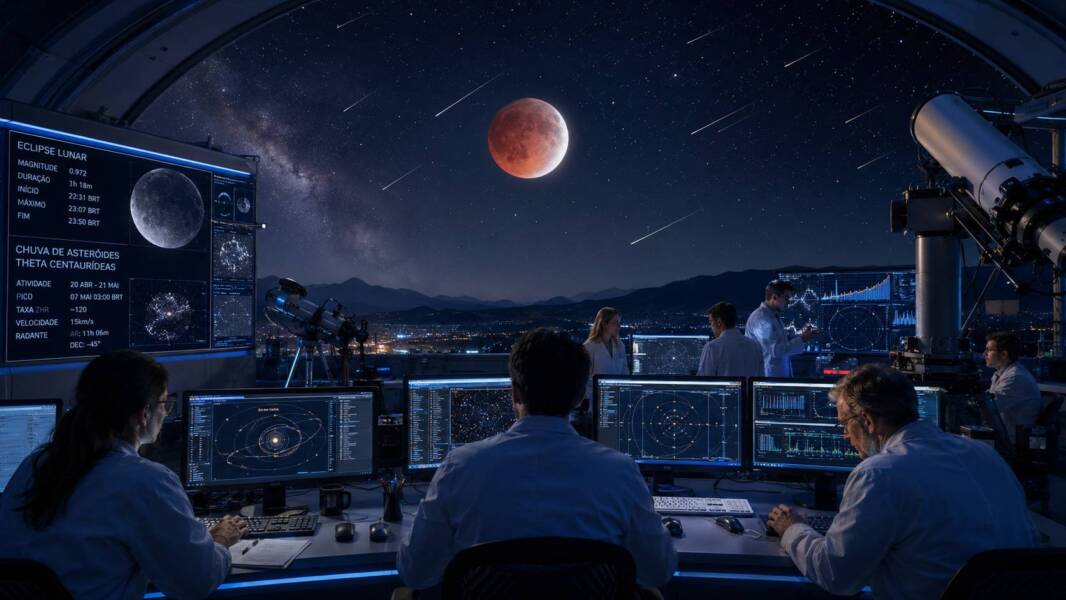
It sounds almost like predicting the future. But when astronomers announce that a solar eclipse will begin at a specific time, cross particular countries and last only a few minutes, they are not guessing.
They are using mathematics, orbital mechanics, telescopes, satellites and increasingly sophisticated computer systems to calculate what will happen in space.
And eclipses are only part of the story.
Modern technology can track asteroids millions of kilometers away, monitor explosions on the Sun, forecast space weather and calculate where objects in the Solar System will travel years into the future.
So how does all of this actually work?
Here’s a closer look at how technology predicts eclipses and other space phenomena — and why these predictions are becoming more powerful than ever.
How Can Scientists Predict an Eclipse So Accurately?
Eclipses may look unpredictable when you see one, but from an astronomical point of view they are extremely orderly events.
A solar eclipse happens when the Moon passes between Earth and the Sun and its shadow falls across part of our planet. A lunar eclipse happens when Earth moves between the Sun and Moon, causing Earth’s shadow to fall across the Moon.
Because astronomers understand the orbits of Earth and the Moon extremely well, computers can calculate when these alignments will occur.
NASA explains that scientists model the three-dimensional movements of Earth, the Moon and the Sun using the laws of motion and gravity. They enter information about their current positions and velocities into computer models, which can then calculate their positions forward or backward in time.
In other words, predicting an eclipse is essentially a gigantic — and extremely precise — geometry problem.
It Starts With Orbital Mechanics
Every planet, moon, asteroid and comet moves according to physical laws.
Gravity determines how these objects interact, while their velocity determines how they continue moving through space.
Using orbital mechanics, scientists can calculate an object’s future position based on information such as:
- its current position;
- its speed and direction;
- the gravitational forces acting on it;
- the shape and orientation of its orbit;
- interactions with other celestial bodies.
These calculations would be incredibly difficult to perform repeatedly by hand.
Modern computers, however, can process huge numbers of equations and simulate the movement of celestial bodies far into the future.
That is one reason astronomers can know the date of an eclipse taking place generations from now.
NASA’s eclipse databases, for example, contain calculations covering thousands of years. Its Five Millennium Canon of Solar Eclipses covers events between 2000 BCE and 3000 CE and includes 11,898 solar eclipses.
Computers Turn Orbits Into Eclipse Maps
Knowing that an eclipse will happen isn’t enough.
People want to know something much more practical:
Can I see it from where I live?
This is where the calculations become more complicated.
Scientists must determine exactly where the Moon’s shadow will cross Earth.
That means accounting for the sizes and positions of the Sun, Moon and Earth, Earth’s rotation and even details of the Moon’s surface.
The result is the familiar eclipse map showing a narrow path of totality for a total solar eclipse.
If you’re inside that path, the Moon can completely cover the Sun.
Move outside it, and you may see only a partial eclipse.
Modern eclipse calculations are extremely precise. NASA notes that current eclipse forecasts can be accurate to less than a minute across periods extending hundreds of years.
There are still limits, however. For example, irregularities along the lunar surface can affect the precise edges of an eclipse path. NASA notes that uncertainties involving the Moon’s limb profile can influence calculated eclipse-path boundaries by roughly 1–2 kilometers.
For most people watching an eclipse, that’s remarkably precise.
The 2026 Total Solar Eclipse Shows the Technology in Action
A great modern example occurred on August 12, 2026, when a total solar eclipse crossed parts of Greenland, Iceland, Spain and other regions.
Long before the event, astronomers already knew where totality would occur, how long it would last and which locations would have the best view.
But scientists were doing much more than simply predicting where the Moon’s shadow would travel.
The European Space Agency also used computer modeling to simulate eclipse conditions and study the solar corona — the Sun’s outer atmosphere that becomes particularly visible during totality.
That matters because the corona is closely connected with another phenomenon that technology tries to predict:
space weather.
Predicting Solar Storms Is Much Harder Than Predicting Eclipses
Eclipses are largely deterministic.
Once you know the orbits involved, you can calculate when the alignment will occur.
The Sun is different.
Our star is constantly changing.
Magnetic activity on the Sun can produce solar flares and enormous eruptions known as coronal mass ejections, or CMEs. These events can send charged particles and magnetic fields racing through space.
If they reach Earth, they may produce beautiful auroras.
Strong events can also interfere with satellites, radio communication, navigation systems and electrical infrastructure.
This is known as space weather.
Instead of simply calculating predictable orbital paths, scientists need continuous observations of the Sun and its surrounding environment.
Spacecraft and ground-based instruments monitor features including:
- sunspots;
- solar magnetic fields;
- solar flares;
- coronal mass ejections;
- the solar wind;
- energetic particles traveling through space.
Computer models then analyze how this material may travel through the Solar System and whether it could interact with Earth’s magnetic field.
The basic idea isn’t too different from terrestrial weather forecasting: collect enormous amounts of observational data, feed it into models and continually update the forecast as new information arrives.
But the environment being predicted is approximately 150 million kilometers away.
Satellites Have Become Our Eyes in Space
A huge part of modern space prediction depends on observation.
You cannot accurately predict what an object will do if you don’t know where it currently is.
That’s why satellites, telescopes and space observatories are so important.
They continuously collect measurements that allow astronomers to refine their models.
For eclipses, precise observations help improve our understanding of the positions and motions of celestial bodies.
For solar activity, spacecraft can observe the Sun at wavelengths that reveal activity our eyes cannot see.
For asteroids, repeated observations allow astronomers to determine their trajectories.
Every additional high-quality observation can make a future prediction more accurate.
And sometimes that can dramatically change what scientists know.
How Technology Predicts Whether an Asteroid Could Hit Earth
Asteroid prediction works differently from eclipse prediction, but the underlying idea is familiar.
First, telescopes discover an object moving against the background stars.
Astronomers then record its position repeatedly.
Computer systems use those observations to determine the orbit that best fits the available data.
Once an orbit has been calculated, scientists can project it forward and determine whether the asteroid will pass near Earth.
NASA’s Center for Near-Earth Object Studies, or CNEOS, calculates the orbits of known near-Earth asteroids and comets and predicts close approaches and possible impact hazards.
But early predictions come with uncertainty.
Suppose astronomers observe an asteroid only a few times.
They know approximately where it is going, but not perfectly.
Instead of a single future position, scientists may initially have a larger region where the asteroid could eventually be located.
More observations shrink that uncertainty.
This creates an important effect that can sometimes make asteroid headlines confusing.
An asteroid’s calculated probability of impact may initially rise before later falling dramatically — or disappearing entirely.
That does not necessarily mean the asteroid suddenly changed direction.
Usually, scientists simply obtained better data.
The Asteroid 2024 YR4 Is a Perfect Example
One recent case demonstrates how powerful this system has become.
Asteroid 2024 YR4 attracted attention after early observations indicated a small but notable possibility of a future impact with Earth.
As astronomers collected more observations, the predicted orbit became much more precise, and NASA determined that the asteroid posed no significant Earth impact risk.
There was still uncertainty about whether it might hit the Moon in 2032.
Then the James Webb Space Telescope entered the picture.
Webb made extremely faint observations of the asteroid in February 2026, allowing scientists to refine its orbit further.
NASA announced in March 2026 that the new observations ruled out the predicted lunar impact as well. Instead, 2024 YR4 is expected to pass about 21,200 kilometers above the lunar surface on December 22, 2032.
This is an excellent example of how modern space prediction works.
Scientists don’t simply make one calculation and consider the job finished.
They continuously update the model as better information becomes available.
The Next Generation of Asteroid Tracking Is Already Being Built
Technology is about to make asteroid detection even more powerful.
NASA is developing NEO Surveyor, the first space telescope specifically designed to find potentially hazardous asteroids and comets.
Its launch is currently planned for no earlier than September 2027.
Unlike traditional visible-light telescopes, NEO Surveyor will use infrared observations.
That’s particularly useful because some asteroids are dark and reflect very little visible light.
They still absorb sunlight and release energy as heat, however, which means infrared detectors can find objects that may be much harder to detect optically.
NASA says the mission’s five-year baseline survey is designed to identify at least two-thirds of near-Earth objects larger than 140 meters.
Its observations will then be processed and combined with other astronomical data so scientists can determine asteroid orbits and assess potential risks years or decades ahead.
Where Does Artificial Intelligence Fit In?
AI is becoming increasingly useful in astronomy, but it shouldn’t be imagined as a machine magically predicting what will happen in space.
Its biggest advantage is pattern recognition and data processing.
Modern telescopes produce enormous datasets.
Finding something interesting inside that information can be like searching millions of photographs for a few pixels that changed.
Machine-learning systems can help researchers:
- identify unusual objects;
- classify astronomical observations;
- detect patterns in telescope data;
- process images faster;
- flag potential discoveries for further investigation;
- compare new measurements against huge historical datasets.
AI therefore complements physics-based models rather than replacing them.
For something like an eclipse, Newtonian mechanics and precise orbital data remain fundamental.
For more chaotic phenomena — such as solar activity — machine learning may help scientists recognize patterns that improve forecasting.
The combination of physics, observation, statistics and AI could become one of the most powerful tools in astronomy.
Digital Simulations Are Creating Virtual Versions of Space
Another important trend is the rise of increasingly detailed computer simulations.
Instead of observing only what is happening right now, scientists can build virtual environments and test what might happen next.
A model might simulate:
- the Moon’s shadow moving across Earth;
- a coronal mass ejection traveling through space;
- an asteroid passing near our planet;
- planetary orbits over thousands of years;
- the effect of changing an asteroid’s trajectory.
These simulations can be run again and again using slightly different assumptions.
That allows researchers not only to make a prediction but also to estimate how confident they should be in it.
This distinction is crucial.
Good science does not simply say, “This will happen.”
It also asks:
“How certain are we?”
Can Technology Predict Every Space Phenomenon?
No — and that distinction is important.
Some astronomical events can be forecast with extraordinary precision because their motion follows well-understood physical patterns.
Eclipses are a perfect example.
Other events are much more difficult.
Scientists cannot currently predict the exact moment of every solar flare months in advance.
They also cannot detect every asteroid immediately.
And events occurring far beyond our Solar System — such as supernova explosions — involve different levels of uncertainty.
Technology does not give astronomers a crystal ball.
What it gives them is something more useful: continuously improving observations combined with mathematical models that can estimate what is likely to happen next.
Why Space Prediction Matters Here on Earth
Predicting an eclipse is fun.
Predicting a dangerous asteroid or major solar storm could be far more important.
Modern civilization depends heavily on technology connected to space.
GPS navigation, satellite communication, weather monitoring, aviation and many financial and communication systems rely directly or indirectly on satellites and precise timing.
Better space-weather forecasting could give operators more time to protect vulnerable infrastructure.
Better asteroid detection could give humanity years — perhaps decades — to respond to a potential threat.
NASA has already demonstrated through the DART mission that deliberately changing the motion of an asteroid is possible. The spacecraft’s 2022 collision with Dimorphos altered the asteroid moonlet’s orbit, and subsequent research has continued measuring the wider effects of the impact.
That transforms asteroid prediction from a purely scientific exercise into part of planetary defense.
First, find the asteroid.
Then determine where it is going.
And if necessary, figure out whether its trajectory can be changed.
The Future of Predicting Space
The next decade should make our view of the Solar System increasingly detailed.
More advanced telescopes will discover faint objects.
Infrared observatories will reveal asteroids that are difficult to see in visible light.
Satellites will provide more detailed observations of the Sun.
AI systems will help researchers process astronomical datasets that are becoming too large to analyze manually.
And increasingly powerful simulations will allow scientists to test enormous numbers of possible scenarios.
The result won’t be perfect knowledge of the future.
But it will mean earlier warnings, more precise forecasts and fewer surprises.
Final Thoughts
So, how does technology predict eclipses and other space phenomena?
The answer is not one single invention.
It’s a system.
Telescopes and satellites observe what is happening. Physics explains how objects move. Computers calculate their future positions. Simulations test different possibilities. And increasingly sophisticated algorithms help scientists process the massive amount of information arriving every day.
For eclipses, this combination is so accurate that scientists can calculate events centuries in advance.
For asteroids and solar storms, predictions constantly improve as new observations arrive.
And that may be the most fascinating part of modern astronomy.
We’re not simply getting better at looking into space.
We’re getting better at understanding what happens next.
Frequently Asked Questions
How are eclipses predicted?
Scientists calculate the positions and orbital movements of the Sun, Earth and Moon using mathematical models based on gravity and orbital mechanics. Computers then determine when the three bodies will align and where the resulting shadow will fall on Earth.
How far in advance can scientists predict eclipses?
Eclipses can be calculated centuries and even thousands of years in advance. NASA maintains solar and lunar eclipse catalogs covering a period of roughly 5,000 years.
Can AI predict eclipses?
AI isn’t necessary for basic eclipse prediction because the movements of Earth and the Moon can already be calculated extremely accurately using physics and orbital mechanics. AI is more useful for processing large astronomical datasets and detecting complex patterns.
Can scientists predict solar storms?
Scientists can monitor the Sun and forecast some aspects of solar activity and space weather, but predicting solar storms is much less precise than predicting eclipses. Solar magnetic activity is considerably more complex than orbital motion.
Can technology predict an asteroid hitting Earth?
Scientists can calculate potential future asteroid encounters by combining telescope observations with orbital models. The prediction becomes more accurate as additional observations reduce uncertainty about the object’s orbit.
What technology is used to track asteroids?
Astronomers use ground-based telescopes, space telescopes, infrared detectors, radar when suitable, computer orbit models and automated monitoring systems. NASA’s upcoming NEO Surveyor will add a dedicated infrared space telescope specifically designed to search for potentially hazardous near-Earth objects.

TechnologyHQ is a platform about business insights, tech, 4IR, digital transformation, AI, Blockchain, Cybersecurity, and social media for businesses.
We manage social media groups with more than 200,000 members with almost 100% engagement.