






















November 25, 2026 | By TechnologyHQ
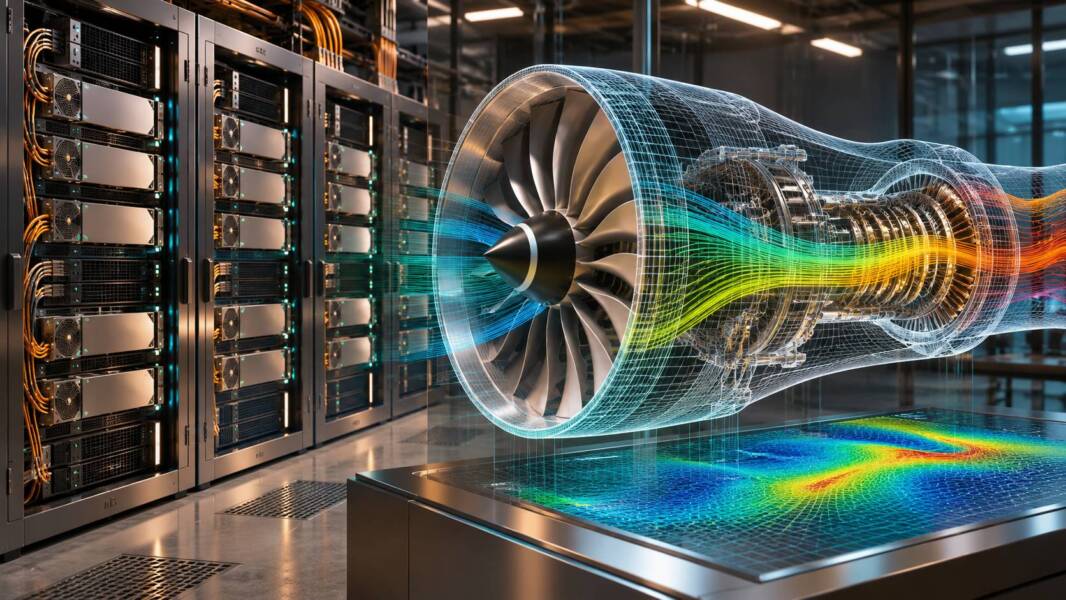
The 40-qubit quantum simulation completed by AMD, Xanadu and Rolls-Royce marks a significant milestone in quantum computing for aerospace engineering, demonstrating how classical supercomputers can support the development of next-generation aircraft engine simulations.
The researchers simulated a quantum circuit representing a 2,048 × 2,048 computational mesh using 64 AMD Instinct MI355X GPUs distributed across eight computing nodes.
The achievement demonstrates how conventional supercomputers can help engineers develop, optimize and validate quantum algorithms before sufficiently powerful fault-tolerant quantum computers become available.
Crucially, the experiment was performed on classical GPU infrastructure rather than a physical 40-qubit quantum processor. It does not establish quantum advantage over conventional engineering methods.
Nevertheless, the results provide valuable evidence about the computational requirements and software architecture needed for future industrial quantum applications.
AMD+2
What the 40-Qubit Quantum Simulation Achieved
The collaboration focused on block encoding, an essential mathematical operation within a candidate quantum algorithm for solving large systems of linear equations.
These equations appear throughout computational fluid dynamics, where engineers calculate how air and other fluids behave under different physical conditions.
The November demonstration significantly expanded the scale of the team’s previous research.
40 qubits
Classical state-vector simulation
2,048²
Approximately 4.19 million mesh cells
64 GPUs
AMD Instinct MI355X
17h 22m
Reported full block-encoding run
According to AMD’s November 24 technical announcement, the experiment executed a circuit containing 716,050 quantum gates.
The collaboration also reported substantial improvements in algorithm efficiency and communication between computing nodes.
| Technical achievement | Reported result |
|---|---|
| Quantum circuit size | 40 qubits |
| Computational mesh | 2,048 × 2,048 |
| State-vector memory | Approximately 17.6 TB |
| GPU count | 64 |
| Computing nodes | 8 |
| Non-Clifford gate reduction | More than 220-fold |
| Cross-node communication reduction | Approximately 90% |
| Compilation time | Under one minute |
These are results reported by the participating research organizations, rather than independently reproduced benchmarks.
Why the 40-Qubit Quantum Simulation Matters for Aircraft Engines
Designing an aircraft engine requires engineers to understand complex interactions between airflow, pressure, temperature, turbulence and mechanical components.
Computational fluid dynamics allows engineers to investigate these interactions through numerical simulations before manufacturing and testing physical prototypes.
Higher-resolution simulations can provide more detailed information about how air moves through compressors, turbines and other engine components.
However, increasing resolution also increases computational requirements.
A sufficiently detailed simulation of an entire aircraft engine may involve enormous numbers of variables and repeated mathematical operations.
Even advanced supercomputers must balance simulation accuracy against available memory, processing capacity and execution time.
How computational fluid dynamics works
A CFD simulation divides a physical region into smaller computational elements known collectively as a mesh.
Numerical methods approximate the governing fluid equations across these elements.
The resulting mathematical systems can become extremely large, especially when engineers require detailed three-dimensional simulations.
Quantum linear solvers are being investigated as a potential alternative for certain mathematical operations within these workflows.
Their practical advantage, however, depends on factors including data preparation, algorithm complexity, hardware reliability and the cost of extracting useful results.
Rolls-Royce’s involvement builds on its earlier quantum computing research for large airflow calculations, announced in November 2025.
How the 40-Qubit Quantum Simulation Was Performed
One of the most important aspects of the experiment is the relationship between classical and quantum computing.
The researchers did not need a physical quantum computer to investigate how the algorithm behaves.
Instead, they used a classical state-vector simulator to mathematically reproduce the evolution of a quantum circuit.
Why quantum simulation requires so much memory
A classical computer simulating an arbitrary pure quantum state must represent its complex amplitudes.
For a system containing \(n\) qubits, the number of amplitudes is:
Every additional qubit doubles the size of the state vector.
Assuming double-precision complex values requiring 16 bytes per amplitude, the theoretical memory requirement becomes:
Quantum simulation memory calculator
40
Minimum theoretical state-vector memory
17.59 TB
1,099,511,627,776 complex amplitudes
Relative to the approximately 18.4 TB of combined GPU memory used in the Lux experiment. Additional simulation buffers are excluded.
At 40 qubits, the simulator must represent approximately 1.1 trillion complex amplitudes.
That explains why classical quantum simulation becomes increasingly difficult as circuit size grows.
| Simulated qubits | Theoretical memory |
|---|---|
| 20 | 16.8 MB |
| 25 | 536.9 MB |
| 30 | 17.2 GB |
| 35 | 549.8 GB |
| 40 | 17.6 TB |
| 45 | 562.9 TB |
The figures above are mathematical estimates for double-precision state-vector simulation, excluding additional software and communication overhead.
Other simulation techniques may require less memory for particular circuit structures, but they do not remove the general scaling challenge.
How AMD GPUs Enabled the 40-Qubit Quantum Simulation
The Lux supercomputer provides the memory capacity and communication infrastructure required to distribute large quantum states across multiple accelerators.
The MI355X GPU configuration used in the research provides 288 GB of high-bandwidth memory per accelerator.
Across 64 GPUs, this creates approximately 18.4 TB of combined memory.
GPU memory requirements
Available combined GPU memory
18.4 TB
40-qubit state vector
17.6 TB
Approximate decimal memory figures. Actual allocation also includes communication buffers and simulator overhead.
Memory capacity alone is not sufficient.
When a quantum state is distributed across many GPUs, certain simulated operations require data to move between accelerators.
The performance of the interconnect and the efficiency of the algorithm become critical.
This is why modern high-performance computing systems must be designed around the combined capabilities of processors, memory, networking and software rather than raw arithmetic throughput alone.
Memory bandwidth versus processing power
A quantum gate can require the simulator to update large portions of the stored state vector.
As the simulated system grows, transferring information through memory may become more expensive than performing the mathematical operation itself.
The Lux experiment illustrates why high-bandwidth memory is increasingly important for advanced scientific computing workloads.
The same architectural consideration appears in large AI models, numerical simulations and other memory-intensive applications.
The Algorithm Behind the 40-Qubit Quantum Simulation
The researchers are investigating quantum linear solvers based on Quantum Singular Value Transformation, commonly abbreviated as QSVT.
QSVT is a mathematical framework that allows quantum algorithms to transform the singular values of matrices encoded into quantum operations.
One potential application is solving linear systems associated with scientific and engineering problems.
However, the matrix must first be represented in a form that a quantum algorithm can manipulate.
This is where block encoding becomes essential.
What is block encoding?
Block encoding represents a mathematical matrix within part of a larger quantum-compatible unitary operation.
It allows quantum algorithms to manipulate matrices that may not themselves correspond directly to valid quantum operations.
For aerospace engineering, the matrix can represent numerical relationships derived from fluid simulations.
Preparing this representation efficiently is important because the solver may need to invoke it repeatedly.
If the encoding process requires too many operations, its resource requirements can undermine the potential advantage of the wider quantum algorithm.
Why reducing non-Clifford gates matters
Quantum algorithms use different categories of operations.
In many fault-tolerant quantum computing architectures, non-Clifford gates require particularly expensive implementation and error-correction resources.
Reducing their number can therefore improve the feasibility of a future hardware implementation.
The research team reported a reduction of more than 220 times in non-Clifford gate count relative to its earlier approach.
The improvement does not mean that aircraft-engine simulations are now 220 times faster. It concerns a specific category of quantum operations within the optimized algorithm.
The PennyLane technical research article explains the algorithmic changes and compilation techniques behind these results.
Scaling Quantum Simulation From 20 to 40 Qubits
In March 2026, the collaboration demonstrated a quantum linear-solver workflow involving a 256 × 256 computational mesh and 20 simulated qubits.
The November experiment increased the mesh dimensions to 2,048 × 2,048 while focusing on the block-encoding component.
Growth in computational mesh size
March 2026
256 × 256
65,536 mesh cells
November 2026
2,048 × 2,048
4,194,304 mesh cells
Increase in mesh cells
64×
Schematic comparison of mesh resolution. The two experiments involved different algorithmic scopes.
The mathematical state-vector memory requirement increased by a factor of approximately one million between 20 and 40 qubits.
That increase demonstrates why classical quantum simulation places substantial demands on supercomputing infrastructure.
The earlier research is documented in Xanadu’s March 2026 aerospace quantum computing announcement.
Importantly, the March and November execution times should not be treated as a direct performance comparison because the experiments did not execute identical workloads.
The Software Stack Behind the 40-Qubit Quantum Simulation
Hardware is only one part of the achievement.
The research also required software capable of compiling and executing large quantum programs efficiently.
The software architecture combines PennyLane for quantum algorithm development, Catalyst for compilation, Lightning for simulation and AMD’s ROCm computing environment.
This combination allows researchers to investigate quantum workloads using existing classical computing infrastructure.
The ability to compile large circuits efficiently is particularly important.
Without suitable compilation techniques, generating a representation of a complex quantum program can itself become a major computational bottleneck.
Xanadu’s official November 24 research announcement provides additional information about the integrated software workflow.
Quantum Simulation vs. Physical Quantum Computing
The distinction between simulation and physical execution is essential when evaluating this development.
| Characteristic | Classical quantum simulation | Physical quantum computing |
|---|---|---|
| Hardware | CPUs and GPUs | Quantum processing units |
| Quantum state | Mathematical representation | Physical quantum system |
| Main scaling challenge | Memory and computation | Qubit quality, control and error correction |
| Typical purpose | Algorithm development and verification | Execution of quantum algorithms |
| Used in the November experiment | Yes | No |
A classical simulator can provide detailed information about the behavior of a quantum algorithm.
A physical quantum computer uses controlled quantum systems to perform operations directly.
Although physical quantum hardware does not need to explicitly store every amplitude in conventional memory, it introduces different challenges involving noise, measurement and fault tolerance.
TechnologyHQ previously examined the physical foundations of quantum hardware in its article on the 2025 Nobel Prize and macroscopic quantum tunneling.
The November aerospace research illustrates the complementary software and algorithmic work needed to translate those physical principles into engineering applications.
Does the 40-Qubit Quantum Simulation Demonstrate Quantum Advantage?
No.
Quantum advantage would require evidence that a quantum computing approach outperforms an appropriate classical alternative for a clearly defined task under meaningful comparison conditions.
The November experiment demonstrates progress in quantum algorithm preparation, resource optimization and large-scale classical simulation.
It does not establish that a quantum computer can currently solve complete aircraft-engine CFD problems faster than conventional supercomputers.
Several technical challenges remain.
Data preparation
Engineering matrices must be encoded into quantum-compatible representations.
The cost of this operation must be included when evaluating the complete algorithm.
Quantum error correction
Future industrial quantum applications may require reliable logical qubits capable of executing deep circuits.
The number of physical qubits required to support those logical qubits depends on the hardware architecture and error-correction scheme.
Extracting useful engineering results
Quantum algorithms may produce a quantum state representing mathematical information rather than a conventional numerical output containing every variable.
Extracting the specific information required by engineers introduces additional computational considerations.
Comparison with optimized classical methods
Classical CFD software continues to improve.
Any future quantum solution must be compared against competitive classical algorithms running on appropriate modern hardware, not an unnecessarily inefficient baseline.
These requirements make the current experiment a meaningful research milestone without establishing a commercially deployable quantum advantage.
What This Development Means for Semiconductor Engineering
The experiment also highlights an important relationship between quantum computing and the semiconductor industry.
Future quantum systems are unlikely to eliminate the need for conventional computing infrastructure.
Classical processors remain useful for algorithm development, compilation, hardware control, error-correction decoding and verification.
Large-scale GPU systems can help researchers investigate potential quantum applications while physical quantum hardware continues to mature.
This suggests that high-performance classical computing and quantum computing may increasingly operate as complementary technologies.
Hybrid quantum-classical infrastructure
A future engineering workflow could use classical systems for mesh generation, data preparation and result analysis, while assigning selected mathematical operations to a quantum processor.
Whether that arrangement produces a meaningful performance advantage will depend on the cost of transferring information between the two computing environments.
The November research contributes to understanding these boundaries.
TechnologyHQ’s broader analysis of emerging technologies shaping the future beyond 2030 provides additional context for quantum computing’s potential role in future scientific and industrial systems.
How Engineering Teams Can Prepare for Quantum Computing Today
Organizations interested in quantum engineering do not necessarily need to wait for large-scale fault-tolerant hardware before beginning research.
A practical starting point is to identify computational bottlenecks within existing scientific workflows.
Potential candidate algorithms can then be evaluated using smaller representative problems and classical quantum simulators.
Engineering teams should prioritize the following activities:
-
Identify mathematical operations that dominate existing simulation workloads.
-
Establish reliable classical performance and accuracy baselines.
-
Evaluate quantum algorithms on representative engineering problems.
-
Estimate logical qubit counts, circuit depth and gate requirements.
-
Include data-loading and measurement costs in performance estimates.
-
Test numerical accuracy against established classical solutions.
-
Investigate hybrid computing architectures before committing to specialized hardware.
The objective should be to establish whether quantum computing offers a credible technical path for a specific problem, rather than assuming that every computationally expensive task will benefit.
Could Quantum Computing Eventually Help Design More Efficient Aircraft Engines?
Potentially, but the environmental and engineering benefits remain prospective.
If future quantum algorithms can accelerate selected high-resolution simulations, engineers may be able to investigate more design configurations or examine physical effects that are currently expensive to model.
That could contribute to improvements in aerodynamic efficiency, combustion performance and engine development.
However, the November experiment does not demonstrate a reduction in aircraft fuel consumption, emissions or manufacturing time.
Those outcomes would require further algorithmic development, suitable quantum hardware, integration into engineering workflows and validation through physical testing.
The immediate contribution is improved understanding of how to prepare a demanding scientific algorithm for future quantum execution.
Frequently Asked Questions
What is a 40-qubit quantum simulation?
It is a mathematical simulation of a quantum system containing 40 qubits. A conventional double-precision state-vector implementation requires approximately 17.6 TB of memory before additional overhead.
Did AMD and Rolls-Royce use a real quantum computer?
No. The November 2026 experiment used classical AMD GPUs installed in the Lux supercomputer.
How many GPUs were required?
The experiment used 64 AMD Instinct MI355X GPUs distributed across eight computing nodes.
How long did the simulation take?
AMD reported an execution time of 17 hours and 22 minutes for the full 40-qubit block-encoding circuit.
What is the role of Xanadu’s PennyLane?
PennyLane provides quantum algorithm development tools that integrate with compilation and simulation software, allowing researchers to develop and evaluate quantum programs.
Has quantum advantage been demonstrated?
No. The research validates a component of a candidate quantum engineering workflow but does not establish superiority over optimized classical CFD solvers.
Can quantum computers already design complete aircraft engines?
The reported experiment does not demonstrate complete quantum-based aircraft engine design. It investigates mathematical operations that could contribute to future engineering workflows.
Conclusion: The Future of Quantum Simulation in Aerospace
The 40-qubit quantum simulation completed by AMD, Xanadu and Rolls-Royce demonstrates how classical supercomputers can contribute to the development of future industrial quantum applications.
The research combines algorithm optimization, large-scale GPU infrastructure and specialized quantum software to investigate a demanding mathematical problem associated with aerospace engineering.
Its most important contribution is not a demonstration of quantum advantage, but progress toward understanding the resources and software required to pursue it.
As quantum hardware develops, research of this kind can help engineering teams identify which applications are technically promising and which computational barriers still need to be overcome.
For now, conventional high-performance computing remains essential to both modern aircraft design and the development of its potential quantum-powered successors.
Sources

Ingrid Maldine is a business writer, editor and management consultant with extensive experience writing and consulting for both start-ups and long established companies. She has ten years management and leadership experience gained at BSkyB in London and Viva Travel Guides in Quito, Ecuador, giving her a depth of insight into innovation in international business. With an MBA from the University of Hull and many years of experience running her own business consultancy, Ingrid’s background allows her to connect with a diverse range of clients, including cutting edge technology and web-based start-ups but also multinationals in need of assistance. Ingrid has played a defining role in shaping organizational strategy for a wide range of different organizations, including for-profit, NGOs and charities. Ingrid has also served on the Board of Directors for the South American Explorers Club in Quito, Ecuador.