





















Artificial intelligence has spent the last few years moving from an interesting technology experiment to something millions of people use every day.
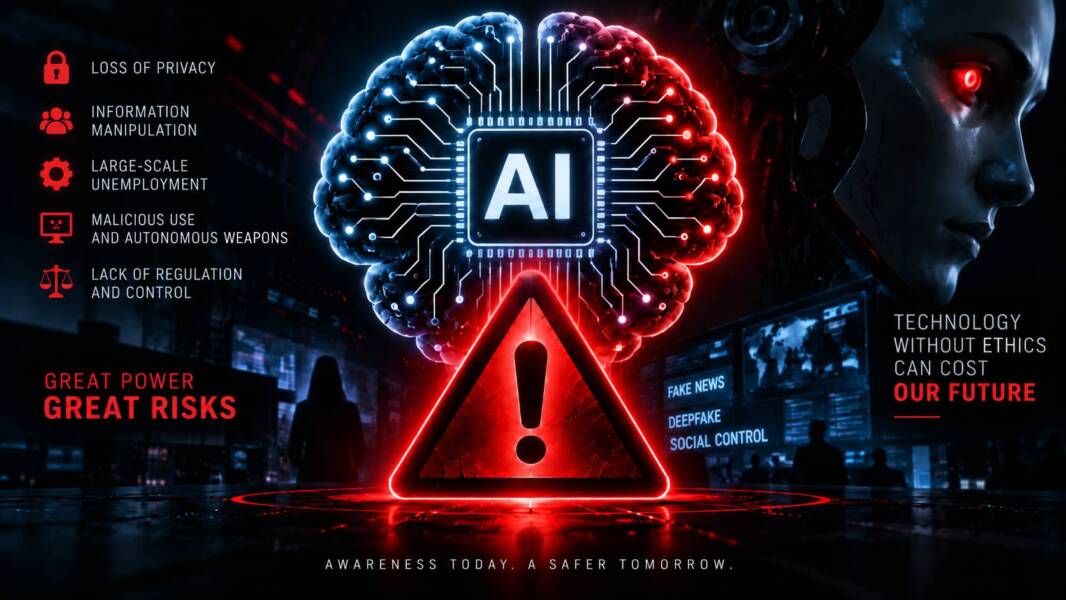
AI can write emails, generate images, summarize documents, analyze data, help programmers create software and even complete increasingly complex tasks on behalf of users.
But as AI becomes more capable, another conversation is getting louder: Are we moving too fast?
In 2026, concerns about artificial intelligence are no longer coming only from people who dislike new technology. Researchers, economists, policymakers and even executives working inside the AI industry are debating how powerful AI systems should become, how they should be tested and what safeguards need to be in place.
The issue isn’t simply that “AI is dangerous.”
The real concern is that AI capabilities are improving faster than our ability to understand, regulate and reliably control how those systems are used.
Stanford University’s 2026 AI Index describes a similar imbalance: AI capabilities continue to advance rapidly, while the systems used to evaluate, govern and understand the technology are struggling to keep pace.
So, why are experts worried about AI right now?
There isn’t one single answer.
There are several.
1. AI Is Becoming Much More Capable
The biggest reason the AI debate has intensified is surprisingly simple: the technology keeps getting better.
Earlier generative AI systems were mainly impressive because they could produce convincing text or images.
Today’s systems are moving beyond simple generation.
They can reason through multi-step problems, write and debug software, interpret images and documents, search through large amounts of information and increasingly perform tasks with limited human supervision.
According to Stanford’s 2026 AI Index, AI performance continues to improve across areas including multimodal reasoning, mathematics and scientific problem-solving. Industry also produced more than 90% of notable frontier AI models in 2025.
That creates an unusual situation.
The more useful AI becomes, the more valuable it becomes.
But the more capable it becomes, the more serious its mistakes can also become.
A chatbot giving you a bad restaurant recommendation is annoying.
An autonomous AI agent making a bad financial decision, modifying software or interacting with critical systems could be considerably more serious.
And that leads to one of the biggest topics in AI right now.
2. AI Agents Are Changing the Risk Equation
For several years, most people interacted with AI by asking a question and receiving an answer.
AI agents work differently.
Instead of simply responding, an agent may be able to perform a sequence of actions.
For example, an AI agent could potentially search the internet, analyze information, use software, write code, communicate with other services and complete a task with relatively little supervision.
That can make AI dramatically more productive.
It also creates new risks.
The 2026 International AI Safety Report highlights AI agents as an area requiring particular attention because autonomous systems can affect other digital — and potentially physical — systems before a human has the opportunity to intervene.
Think about the difference this way.
A traditional chatbot might incorrectly tell you how to change a computer configuration.
An AI agent might actually change it.
That distinction is important.
Researchers are therefore studying questions such as:
Can an AI reliably follow complex instructions?
Will it recognize when it should stop?
Can humans understand what it is doing?
Can it be manipulated by malicious instructions?
What happens when several AI agents interact with one another?
These are no longer purely theoretical questions.
As businesses begin deploying AI agents for real tasks, reliability becomes just as important as intelligence.
3. AI Still Makes Mistakes — Even When It Sounds Confident
Anyone who has used generative AI extensively has probably encountered this problem.
AI can be extremely convincing even when it is wrong.
These errors are often called hallucinations.
AI models have improved significantly, but reliability remains a major challenge, especially when systems are asked to handle complicated tasks.
The International AI Safety Report notes that modern AI systems can still fabricate information, produce flawed code and provide misleading advice. Although reliability has improved, current techniques cannot guarantee the level of accuracy required for every high-stakes application.
This matters because AI is increasingly being considered for areas involving medicine, finance, education, law, cybersecurity and business decision-making.
Imagine an AI system being correct 98% of the time.
That sounds excellent.
But if it processes one million important decisions, a 2% error rate could still mean 20,000 problematic results.
That is why researchers aren’t only asking:
“How intelligent is this AI?”
They’re increasingly asking:
“How reliably can we trust it?”
4. Jobs Remain One of the Biggest AI Concerns
For most people, the most immediate AI concern isn’t science-fiction superintelligence.
It’s their job.
Generative AI is particularly good at tasks involving information: writing, translation, administration, research, programming, analysis and customer communication.
Naturally, workers in those fields are wondering what happens next.
But current research paints a more complicated picture than the simple claim that “AI will take everyone’s jobs.”
A major International Labour Organization study concluded that around one in four workers worldwide is employed in an occupation with some degree of exposure to generative AI.
However, the ILO says job transformation rather than complete replacement remains the more likely outcome for most workers.
Clerical and administrative jobs remain particularly exposed, while AI’s expanding capabilities are also affecting professional and technical roles.
The important distinction is between a job and the tasks inside that job.
A lawyer, accountant, programmer or marketing professional might still exist five years from now.
But many of the activities performed during their working day could increasingly be handled by AI.
That could improve productivity.
It could also reduce the number of people required for certain tasks.
The economic impact therefore depends heavily on how companies use the technology.
5. Deepfakes and AI-Generated Content Are Becoming Harder to Ignore
Another major concern involves something almost everyone experiences: information.
Generative AI can now create increasingly convincing text, voices, images and video.
That has enormous creative potential.
It also means creating fake content is becoming easier and cheaper.
Scammers can imitate voices.
Fake images can spread rapidly online.
AI-generated personalities can impersonate real people.
Synthetic videos can make someone appear to say something they never said.
And automated systems can potentially produce enormous quantities of misleading content.
The problem isn’t simply that fake information exists. Fake photographs and misinformation existed long before generative AI.
The difference is scale.
AI drastically reduces the cost and effort needed to manufacture convincing content.
As a result, one of the biggest challenges of the AI era may eventually become proving that something is real rather than simply detecting that something is fake.
This issue is already influencing regulation.
In the European Union, transparency requirements under the AI Act have become an important part of the regulatory framework, including rules covering certain AI-generated or manipulated content. Most of the Act’s transparency rules began applying on August 2, 2026.
6. Cybersecurity Could Become an AI Arms Race
Cybersecurity is another area experts are watching very closely.
AI can help defenders detect suspicious behavior, analyze malware and identify security vulnerabilities faster.
Unfortunately, attackers can use AI too.
Generative AI can potentially help criminals produce more convincing phishing messages, automate parts of cyberattacks or discover vulnerabilities.
That creates an unusual technological race.
The same AI capability that makes defensive cybersecurity more powerful can sometimes make offensive cyber activity more scalable.
The 2026 International AI Safety Report categorizes malicious use — including certain cybersecurity threats — among the major risks associated with increasingly powerful general-purpose AI systems.
The result may be a future where both attackers and defenders use increasingly sophisticated AI systems against each other.
7. Nobody Fully Understands How Advanced AI Makes Every Decision
This is one of the stranger aspects of modern artificial intelligence.
Engineers build the systems.
They train them.
They test them.
But that doesn’t mean they can always explain exactly why a large neural network produced a particular result.
Modern AI models contain enormous numbers of parameters and learn complicated internal representations during training.
Researchers can analyze these models, but understanding every internal mechanism remains extremely difficult.
The International AI Safety Report notes that even developers of general-purpose models may struggle to fully explain model behavior, predict every failure mode or prove that specific failures won’t occur.
That becomes more important as systems grow more capable.
If an AI helps you rewrite a birthday invitation, complete interpretability isn’t particularly important.
If an AI is involved in financial infrastructure, cybersecurity or autonomous decision-making, understanding why it behaves a certain way becomes much more significant.
8. AI’s Energy Appetite Is Growing
AI might feel like software floating somewhere in “the cloud,” but behind every model are physical machines.
Lots of them.
Powerful AI models run inside data centers containing huge numbers of specialized chips.
Those facilities require electricity for computing and cooling.
And as demand for AI grows, so does the infrastructure supporting it.
The International Energy Agency projects that global electricity consumption by data centers could more than double to around 945 terawatt-hours by 2030, with AI identified as the most important driver of that growth alongside other digital services.
That doesn’t automatically mean AI is environmentally disastrous.
AI can also improve energy systems, scientific research, logistics and efficiency.
But the rapid construction of AI infrastructure raises legitimate questions about electricity grids, water use, emissions and where future energy supplies will come from.
The physical footprint of artificial intelligence is becoming impossible to separate from the digital one.
9. Governments Are Trying to Regulate Something That Changes Extremely Fast
There is another fundamental problem.
Technology moves quickly.
Law usually doesn’t.
An AI model can be developed, released and adopted by millions of users in months.
Major legislation can take years.
The European Union’s AI Act represents one of the world’s most significant attempts to regulate artificial intelligence using a risk-based framework.
Its provisions are being introduced progressively. General-purpose AI rules began applying in August 2025, while many additional provisions and transparency requirements entered into application in August 2026.
But governments face a difficult balancing act.
Regulate too little, and harmful AI applications might spread without adequate safeguards.
Regulate too aggressively, and governments risk slowing innovation, creating barriers for smaller companies or concentrating AI development inside a handful of giant corporations capable of meeting expensive compliance requirements.
There is no universally accepted solution yet.
10. Then There Is the Biggest Question: Could Humans Eventually Lose Control?
This is the most controversial AI concern.
Some researchers believe extremely advanced AI could eventually become difficult or impossible to control if its abilities significantly exceed human capabilities.
Others argue that discussions about hypothetical superintelligence can distract attention from real problems happening today, such as fraud, bias, surveillance, labor disruption and misinformation.
Both perspectives are part of the current debate.
Importantly, the 2026 International AI Safety Report distinguishes current systems from hypothetical future systems. It states that today’s AI systems do not currently possess the capabilities required for genuine loss-of-control scenarios, although researchers are watching improvements in areas such as autonomous operation.
So headlines claiming that today’s chatbots are about to “take over the world” seriously oversimplify the evidence.
But dismissing the subject entirely would also be misleading.
Researchers study low-probability but high-impact risks precisely because waiting until a dangerous capability exists could be too late to develop adequate safeguards.
Should We Actually Be Afraid of AI?
Probably the wrong question is:
“Is AI good or bad?”
AI is a technology, and extraordinarily powerful technologies rarely fit neatly into either category.
Electricity transformed civilization.
The internet transformed communication.
Smartphones transformed how billions of people access information.
Each created enormous benefits while introducing problems society later had to manage.
AI appears likely to follow a similar pattern — potentially on an even larger scale.
The more useful question is:
Can we capture the benefits of increasingly powerful AI while keeping the risks manageable?
That means improving safety testing.
It means creating reliable ways to identify AI-generated material.
It means preparing workers for changing jobs.
It means protecting critical systems.
It means monitoring energy consumption.
And it means creating sensible rules without making useful innovation impossible.
What Experts Are Watching Next
Over the next few years, the most important development may not be one spectacular new AI model.
Instead, watch what AI becomes capable of doing without continuous human supervision.
The move from chatbots that answer questions to AI agents that execute tasks could fundamentally change how companies use artificial intelligence.
At the same time, researchers will be watching reliability, cybersecurity capabilities, autonomous decision-making, labor-market effects and whether governments can develop effective safety standards.
One number from Stanford’s 2026 AI Index captures the uncertainty particularly well.
When surveyed about AI’s effect on people’s jobs, 73% of AI experts expected a positive impact, compared with only 23% of the public.
That 50-point gap reveals something important.
The people developing and studying AI often see enormous potential.
The public sees enormous uncertainty.
Both reactions make sense.
The Bottom Line
The current concern surrounding artificial intelligence isn’t simply another round of technology panic.
AI systems really are becoming more capable.
Businesses really are integrating them into important workflows.
Jobs really will change.
Synthetic content really is becoming harder to distinguish from authentic material.
And increasingly autonomous AI systems create questions we haven’t had to answer before.
But concern shouldn’t automatically become panic.
Today’s evidence doesn’t support the idea that every job is about to disappear or that current AI systems are moments away from taking control of civilization.
What it does show is that society is entering a period where AI capabilities may advance faster than institutions, laws and safety mechanisms can adapt.
And that is exactly why experts are paying attention.
The most important AI story of the next few years may not be whether machines become smarter.
It may be whether humans become better at deciding how, where and when those machines should be trusted.
Frequently Asked Questions
Why are people worried about AI in 2026?
The biggest concerns include increasingly autonomous AI agents, job disruption, misinformation and deepfakes, cybersecurity, reliability problems, energy consumption and whether regulation can keep pace with rapid technological development.
Will AI replace jobs?
AI is likely to automate tasks within many occupations, but complete job replacement is less certain. The International Labour Organization says transformation rather than total replacement is currently the more likely outcome for most exposed occupations.
What are AI agents?
AI agents are systems designed to perform sequences of actions toward a goal rather than simply answering individual prompts. They may use software, search information, process data and interact with other systems with varying levels of autonomy.
Is artificial intelligence dangerous?
AI already presents practical risks involving fraud, misinformation, cybersecurity, incorrect outputs and misuse. More extreme future risks remain uncertain and are actively debated and researched.
Is AI regulation already happening?
Yes. Governments around the world are developing AI rules. In the European Union, the AI Act is being implemented progressively, with several major provisions already applying as of 2026.
What should we watch next in AI?
AI agents, autonomous systems, cybersecurity capabilities, workplace automation, regulation and improvements in model reliability are among the most important areas to follow.

TechnologyHQ is a platform about business insights, tech, 4IR, digital transformation, AI, Blockchain, Cybersecurity, and social media for businesses.
We manage social media groups with more than 200,000 members with almost 100% engagement.