
















A Quantum Surprise: When Particles Behave Like Grownups
Imagine tossing a ball at a wall and, instead of bouncing back, the ball simply phases through and appears on the other side. In the realm of quantum mechanics, that weird idea is real—but only for tiny particles. Until now.
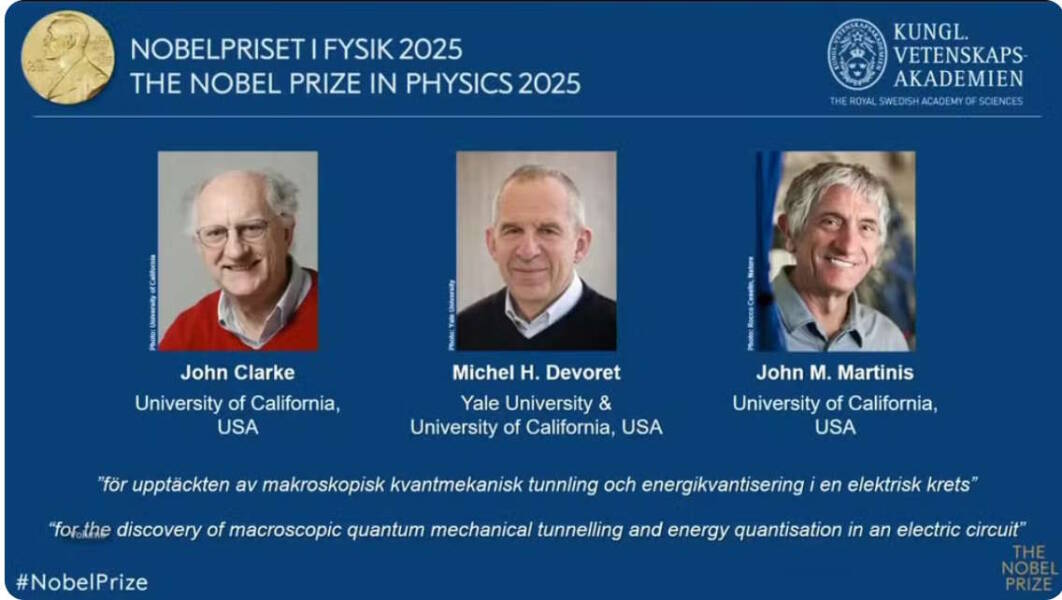
In October 2025, the Nobel Prize in Physics went to John Clarke, Michel H. Devoret, and John M. Martinis for making that “impossible” happen—not with single particles, but with electrical circuits you can hold in your hand. Their experiments demonstrated macroscopic quantum tunneling and energy quantization in superconducting circuits. In short: they showed that weird quantum effects can scale up. That’s huge.
The Big Announcement: Nobel 2025 Honors Quantum Pioneers
The Royal Swedish Academy of Sciences awarded the 2025 Physics Nobel to Clarke, Devoret, and Martinis “for the discovery of macroscopic quantum mechanical tunneling and energy quantization in an electric circuit.”
These experiments date back to the 1980s. The trio built superconducting circuits that defied intuition: they showed that a circuit’s “state” could jump (tunnel) through an energy barrier and could occupy only discrete energy levels, even though the circuit is macroscopic.
Why is this worthy of a Nobel? Because it blurred the boundary between the microscopic quantum realm and the classical world we live in—and laid the groundwork for the quantum computers and sensors of tomorrow.
Why This Discovery Matters
You might ask: we already use quantum mechanics in transistors and lasers and MRI machines—so what’s new here?
-
Scaling quantum behavior: Until these experiments, quantum effects like tunneling and energy quantization were thought to only exist for atoms, molecules, or photons. Doing the same in a circuit with billions of electrons is a game changer.
-
Foundational for superconducting qubits: Many of today’s quantum computers use superconducting circuits (qubits) that exploit the same principles proven in these seminal experiments. The laureates’ work is the bedrock of that architecture.
-
Bridging theory and application: This is not pure abstract theory—these quantum features are directly relevant to technologies in cryptography, high-sensitivity sensors, quantum simulators, and more.
-
Challenging the classical-quantum divide: We all learned in school that “quantum weirdness” vanishes at large scales. But these experiments show that under the right conditions, macroscopic objects can behave quantumly.
Demystifying the Science: Tunneling, Quantization & Circuits
Let’s dive in—but in plain language.
Classical vs Quantum: Where Intuition Breaks
In everyday life (classical physics), objects move in continuous ways. Energy is also continuous: you can give a ball 1.0 J, or 1.1 J, or 1.1234 J, etc. Barriers are barriers—you bounce off them.
In quantum mechanics, particles have wave-like behavior and occupy discrete energy levels (quantization). Also, particles can tunnel through barriers: there’s a probability that they appear on the other side even if they lack the “classical energy” to cross.
Quantum tunneling is well known in nuclear decay, scanning tunneling microscopes, and semiconductor physics. But the challenge had been: can entire circuits—many electrons acting together—show the same?
Superconductors & Josephson Junctions
Superconductors are materials that, when cooled below a critical temperature, conduct electricity with zero resistance. In that state, electrons form “Cooper pairs” that behave coherently.
A Josephson junction is made by placing a thin insulating barrier between two superconductors. Quantum mechanics predicts that Cooper pairs can tunnel through that barrier, producing phenomena like the Josephson effect (a supercurrent flowing without voltage).
The critical idea is: the phase difference (quantum phase) between the two superconductors becomes a collective macroscopic variable that can behave like a “particle” in a potential well.
The 1980s Experiments: How They Did It
Here’s a simplified “movie” of what Clarke, Devoret, and Martinis did:
-
Circuit setup: They built a superconducting circuit with a Josephson junction and cooled it to extremely low temperatures (millikelvin) to reduce thermal noise.
-
Biasing current: They applied a controlled current to the circuit and observed its behavior.
-
Zero-voltage metastable state: The circuit could sit in a stable state (zero-voltage) until quantum tunneling caused it to “escape” into a different state.
-
Observing discrete energy levels: By applying microwaves and varying bias, they could detect that the system had discrete quantized energy levels.
-
Tunneling from discrete levels: Even from excited quantized states, the macroscopic variable could tunnel out—just like a particle escaping a barrier.
-
Comparison with theory: The observed tunneling rates and energy levels matched the theoretical predictions for a quantum particle.
In their 2025 Nobel documentation, the committee cites “Measurement of Macroscopic Quantum Tunneling out of a Zero-Voltage State of a Current-Biased Josephson Junction” as a foundational paper.
Those results confirmed that the collective degrees of freedom in a macroscopic superconducting circuit obey quantum mechanics nearly as cleanly as single particles do.
From Lab to Quantum Computers: Real-World Consequences
So, those 1980s experiments might seem like elegant physics—but they also enabled real-world quantum tech.
Superconducting Qubits
Many leading quantum computing platforms today (e.g. those from Google, IBM, Rigetti) use superconducting circuits (qubits) that exploit quantization and coherent tunneling. The foundational experiments by Clarke, Devoret, and Martinis are deeply intertwined with the design principles of these devices.
In fact, Martinis later led Google’s Quantum AI Lab in building superconducting-based quantum processors.
Quantum Sensors, Clocks & Metrology
The same principles that enable macroscopic quantum coherence can be used for extremely sensitive devices—magnetometers, gravimeters, quantum-enhanced sensors—that outperform classical analogs.
Quantum Cryptography & Communication
Precise control over quantum systems (including energy levels and tunneling) is important for quantum error correction, protocols, and secure quantum communication channels.
Fundamental Physics & Quantum Foundations
These experiments push the boundary: How large can a quantum system be? What is the quantum-to-classical transition? Insights gained here inform decoherence theory, entanglement in macroscopic systems, and the nature of measurement.
Meet the Laureates: Clarke, Devoret & Martinis
Let’s drop the equations for a moment and look at the humans behind the science.
John Clarke
Clarke is emeritus professor at UC Berkeley. He was honored for leading the early experimental efforts on macroscopic quantum tunneling in circuits.
His broader work includes the invention and use of superconducting quantum interference devices (SQUIDs) for ultrasensitive magnetometry, detection of NMR signals, geophysical sensing, and dark matter search amplifiers.
He told the Berkeley press that winning the Nobel “was the surprise of my life.”
Michel H. Devoret
Devoret is a French-born physicist, professor at Yale and affiliated with UC Santa Barbara. He is known for pioneering quantronics (circuit quantum electrodynamics) and the single-electron pump.
He did postdoctoral work in Clarke’s lab, contributing directly to the core experiments.
John M. Martinis
Martinis is an American physicist and professor at UC Santa Barbara. He was instrumental in bringing these experiments to fruition.
He later led quantum computing efforts at Google (2014–2020) using superconducting qubit platforms. His doctoral thesis was titled “Macroscopic quantum tunneling and energy-level quantization in the zero voltage state of the current-biased Josephson junction.”
Challenges, Open Questions & Future Directions
Even after winning a Nobel, the work is far from over. Here are some of the big questions and hurdles:
-
Decoherence & noise: Maintaining quantum coherence in macroscopic circuits is hard. Coupling to the environment tends to destroy the delicate superposition states.
-
Scalability: Moving from single qubits to large-scale quantum processors requires error correction, architecture improvements, and materials innovation.
-
Robust macroscopic superpositions: Can we push quantum behavior to larger masses or everyday-scale systems?
-
Alternative platforms: Many quantum platforms exist (trapped ions, photonics, spin qubits, topological qubits). Superconducting circuits compete but must improve in coherence, gate fidelity, and cost.
-
Fundamental insights into the quantum-to-classical boundary: Where does quantum end and classical begin? These experiments are part of the roadmap.
How to Talk About It (Without Getting Lost in Jargon)
If you explain this to a non-physicist:
-
Use analogies: A marble in a hill-shaped valley (potential well) might tunnel through a barrier it can’t climb.
-
Emphasize “quantum in large things”: The surprising fact is not that tunneling exists, but that entire circuits can show it.
-
Relate to everyday tech: Many devices you use—from MRIs to sensors—rest on quantum mechanics. This work helps take quantum from the lab into tech.
-
Don’t overpromise: It’s foundational work. Real-world quantum computers are still under development, and many challenges remain.
Conclusion: A Quantum Leap Into the Macroscopic
The 2025 Physics Nobel sends a message: quantum mechanics is not confined to atoms and electrons. It can emerge in circuits you can touch and measure. That insight, pioneered decades ago by Clarke, Devoret, and Martinis, has become a fundamental pillar of quantum computing, sensors, and future technologies.
We stand at a crossroads: experiments once considered fascinating now underpin the frontiers of computation, measurement, and encryption. The barrier between the quantum and classical worlds is thinner than ever imagined.
Let’s get excited—not just about what has been discovered, but what lies ahead. Maybe you’ll be part of it.
References
-
The official Nobel Prize advanced description of the 2025 Physics award (pdf) — includes technical details and citations.
-
American Institute of Physics press release on the 2025 Nobel winners.
-
Scientific American article: “The 2025 Nobel Prize in Physics Goes to Researchers Who Showed Quantum Tunneling on a Chip” Scientific American
-
Reuters coverage: “Nobel physics prize goes to pioneers of quantum mechanics”
-
Wikipedia pages on John M. Martinis and Michel Devoret for background bios.

TechnologyHQ is a platform about business insights, tech, 4IR, digital transformation, AI, Blockchain, Cybersecurity, and social media for businesses.
We manage social media groups with more than 200,000 members with almost 100% engagement.