























GitHub Dependabot APM support introduces automated version updates for dependencies used by AI coding agents, bringing a familiar software maintenance workflow to prompts, reusable skills and agent instructions.
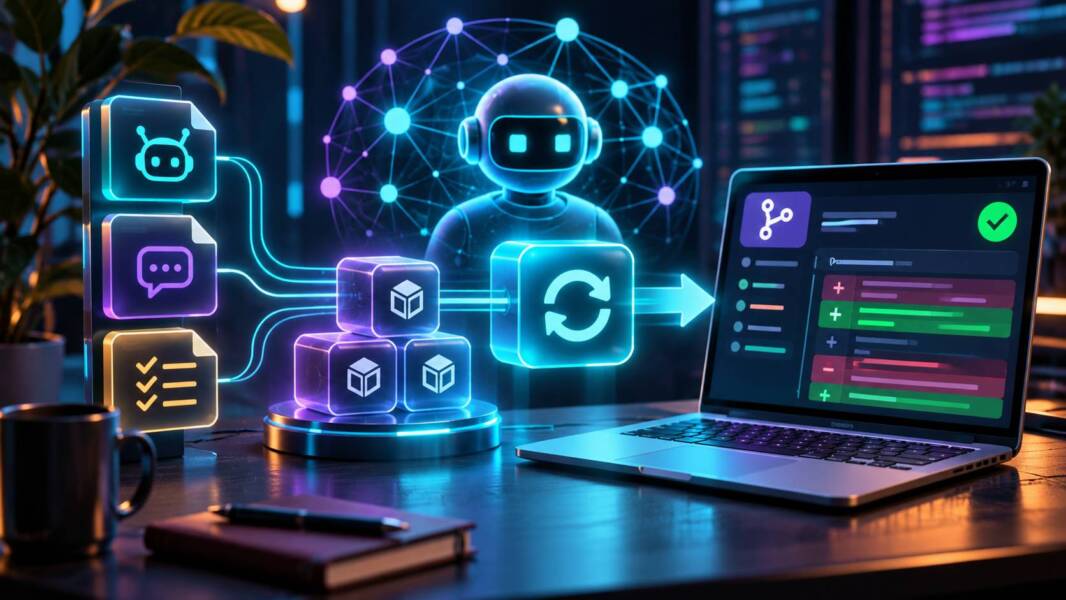
Announced on November 3, 2026, the integration allows Dependabot to identify supported Git dependencies declared in an Agent Package Manager manifest, propose updates through pull requests and regenerate an existing lockfile.
The capability is generally available on GitHub.com across all GitHub plans. GitHub says support will also arrive in GitHub Enterprise Server 3.24.
GitHub Changelog
The change addresses an emerging engineering challenge: AI agents increasingly rely on reusable instructions and tools maintained outside the application repository. Those dependencies can evolve independently, potentially changing an agent’s behavior even when the application’s own source code remains untouched.
For development teams, automated updates make that dependency layer easier to maintain. But they also introduce a question that conventional package managers do not fully answer: how should teams validate changes to instructions that influence an AI system’s decisions?
What Is GitHub Dependabot APM Support?
Agent Package Manager is a system for organizing and distributing reusable AI-agent components, including prompts, instructions and skills.
These components are sometimes called agent primitives. Rather than copying the same instruction files across multiple projects, teams can maintain them as shared dependencies.
GitHub’s integration adds APM as a supported ecosystem for Dependabot version updates.
When configured, Dependabot examines supported Git references in apm.yml, determines whether newer revisions are available and opens pull requests proposing the changes.
If an apm.lock.yaml file already exists, Dependabot regenerates it using apm lock.
The distinction between a manifest and a lockfile is important. The manifest describes requested dependencies, while the lockfile records resolved dependency information used to improve reproducibility.
Why AI agent dependencies need version control
A reusable AI skill might define how an agent reviews code, writes tests, investigates vulnerabilities or generates documentation.
If that skill changes, the agent may begin following different procedures or producing different outputs.
For example, a shared code-review instruction could introduce a new requirement to check authorization boundaries. That might improve security coverage, but it could also change the review’s length, scope and behavior.
Treating these instructions as versioned dependencies allows engineering teams to inspect updates rather than silently adopting whatever happens to be current.
GitHub’s support for APM makes this process resemble dependency maintenance for traditional application packages.
How GitHub Dependabot APM Updates Work
GitHub’s documentation identifies several supported reference types, each with different update behavior.
GitHub Docs
| Dependency reference | Dependabot behavior |
|---|---|
| Semantic-version tag | Updates to the latest supported SemVer tag |
| Full commit SHA | Updates to the commit associated with the latest qualifying annotated release tag |
| Branch reference | Updates the lockfile to the latest branch commit |
| Local path | Not supported for automatic updates |
| Unreferenced Git dependency | Not updated |
Semantic-version tags
A dependency written with a version tag, such as example-org/agent-skills#v1.0.0, can be updated when a newer eligible release becomes available.
Dependabot also supports package-scoped tags following the documented naming rules.
This makes versioned releases useful for teams that want clear change boundaries.
However, a newer version is not necessarily compatible with every existing agent workflow. Semantic versioning communicates an author’s intended compatibility contract; it does not replace testing.
Commit SHA references
Some organizations prefer pinning dependencies to exact Git commits.
GitHub’s APM integration supports full 40-character commit SHAs and can propose moving the dependency to the commit associated with the latest qualifying annotated, non-prerelease release tag.
This approach can preserve precise dependency identification while allowing controlled update proposals.
It is particularly useful when reproducibility matters and teams do not want dependencies to change without an explicit review.
Branch references
Dependencies referencing a branch, such as main, behave differently.
Dependabot can update the resolved commit in apm.lock.yaml while leaving the branch reference in the manifest unchanged.
This requires an existing lockfile.
Branch-based dependencies can move more frequently than tagged releases, so teams should consider whether that update pattern fits their operational risk.
How to Configure Dependabot for Agent Package Manager
GitHub’s documented setup uses the repository’s .github/dependabot.yml configuration file.
For an APM manifest in the repository root, a basic configuration is:
version: 2
updates:
  - package-ecosystem: "apm"
    directory: "/"
    schedule:
      interval: "weekly"
This example tells Dependabot to check supported APM dependencies in the root directory on a weekly schedule.
The directory value must match the location containing the project’s apm.yml file.
If a repository stores its APM manifest in a subdirectory, the configuration should point to that location instead.
After committing the configuration, maintainers can inspect the resulting update pull requests and review any proposed changes.
GitHub’s Dependabot configuration guide explains the general setup and available scheduling options.
What happens to apm.lock.yaml?
If an APM lockfile already exists, Dependabot regenerates it when updating supported dependencies.
It does not automatically create a lockfile when one is absent.
That distinction matters for reproducible development environments. Teams relying on resolved dependency versions should maintain their lockfiles deliberately and include them in code review.
What GitHub Dependabot APM Does Not Support
The November release is specifically about version updates, not security updates.
That means organizations should not assume that APM dependencies automatically receive vulnerability alerts or emergency security remediation pull requests through this integration.
GitHub’s documentation also excludes several dependency forms from automatic updates, including object-form entries, MCP entries, local paths, abbreviated SHAs and certain URL or YAML representations.
Some shorthand references are also excluded when a default registry configuration is present.
These limitations mean the integration does not automatically manage every component used by an AI agent.
MCP dependencies are a separate consideration
Model Context Protocol servers can connect AI agents to external tools and data sources.
Although APM can be used within broader agent workflows that involve MCP, GitHub’s current Dependabot APM documentation explicitly excludes mcp: entries from this updater.
Organizations should therefore maintain a separate process for reviewing MCP server versions, permissions and security implications.
This is especially important for servers that can access repositories, execute commands, retrieve internal data or interact with external services.
Why AI Agent Package Updates Are a Supply-Chain Security Issue
Traditional software dependencies contain executable code, libraries or other artifacts consumed by applications.
AI agent dependencies may instead contain natural-language instructions that influence how a model behaves.
This creates a different type of supply-chain risk.
A compromised instruction package might encourage an agent to disclose sensitive information, use an unsafe tool, ignore a validation step or modify files outside its intended scope.
Such an attack does not necessarily require malicious executable code inside the package itself. The instructions may become dangerous when interpreted by an agent with access to powerful tools.
Automated dependency updates can improve maintenance visibility, but they do not establish that a newly released instruction package is trustworthy.
Why pull-request review is essential
An APM update should be reviewed for more than its version number.
Maintainers should inspect changes to prompts, tool-use instructions, external resource references and requested permissions.
They should also consider whether the new dependency version introduces instructions that conflict with repository security policies.
This is closely related to TechnologyHQ’s previous coverage of GitHub secret scanning improvements, which explains why credential protection remains critical in automated development environments.
An agent dependency that changes how tools are invoked can affect the security of the entire workflow, even when no application dependency has changed.
How to Test AI Agent Dependency Updates Safely
A practical validation process should combine traditional dependency review with behavior-oriented testing.
First, maintain a known-good baseline of agent instructions and expected outputs.
Then evaluate proposed updates against representative tasks. These might include code review, test generation, documentation changes and security-sensitive operations.
For each update, compare whether the agent still follows required instructions, respects tool restrictions and produces acceptable results.
Where possible, test in an isolated environment without production credentials or unrestricted external access.
A recommended review checklist
-
Inspect the source repository and exact revision being introduced.
-
Compare changed prompts, instructions and skills.
-
Review any new tool requirements or external references.
-
Check the manifest and lockfile changes together.
-
Run representative agent tasks in a controlled environment.
-
Confirm that the agent respects existing security boundaries.
-
Require appropriate human approval before merging.
The objective is not to prevent agent packages from evolving. It is to ensure that dependency updates remain visible, reproducible and subject to the same engineering discipline applied to application code.
How Dependabot APM Fits With CodeQL and Secret Scanning
Dependabot, CodeQL and secret scanning address different parts of the software supply chain.
Dependabot helps maintain dependency versions. CodeQL analyzes code for supported vulnerability patterns. Secret scanning searches for exposed credentials.
TechnologyHQ’s CodeQL 2.27.4 analysis examines how improved static-analysis queries can make security findings more accurate.
Neither CodeQL nor secret scanning should be assumed to validate the behavioral safety of every natural-language instruction introduced through APM.
That gap is why organizations need explicit testing and governance for AI agent packages.
What Developers Should Watch Next
The immediate benefit of the November release is simpler maintenance for supported APM Git dependencies.
The longer-term implication is that AI-agent configuration is becoming a first-class part of software dependency management.
As organizations reuse more prompts, skills and agent workflows, the need for controlled distribution, dependency tracking and automated testing is likely to increase.
GitHub has not announced that the new APM integration provides universal security scanning, complete agent-behavior verification or automatic protection against prompt injection.
Those capabilities should not be inferred from version-update support alone.
For now, teams can use the new integration to reduce manual maintenance while retaining explicit responsibility for reviewing what their agents are instructed to do.
Frequently Asked Questions
Does Dependabot support Agent Package Manager?
Yes. GitHub announced general availability for Dependabot APM version updates on GitHub.com on November 3, 2026.
Does Dependabot automatically fix vulnerable APM packages?
No. The announced integration supports version updates, not Dependabot security updates.
Can Dependabot update APM lockfiles?
Yes. It regenerates an existing apm.lock.yaml when supported dependencies are updated, but it does not create a missing lockfile.
Does Dependabot update MCP server dependencies in APM?
Not through the currently documented APM updater. GitHub lists mcp: entries among the unsupported dependency forms.
Is APM support available on GitHub Enterprise Server?
GitHub says the feature is planned for GitHub Enterprise Server 3.24. The announcement does not mean every existing Enterprise Server installation already has it.
The Bottom Line
GitHub Dependabot APM support is a useful development in the management of AI coding agents.
It extends familiar dependency-update workflows to reusable prompts, instructions and skills, making it easier to track changes through pull requests and maintain consistent versions.
Its limitations are equally important: the integration does not provide automatic security updates for APM dependencies, and it does not verify that changed agent instructions are safe.
The strongest approach is to combine automated version discovery with careful change review, controlled agent testing and least-privilege tool access.

Ingrid Maldine is a business writer, editor and management consultant with extensive experience writing and consulting for both start-ups and long established companies. She has ten years management and leadership experience gained at BSkyB in London and Viva Travel Guides in Quito, Ecuador, giving her a depth of insight into innovation in international business. With an MBA from the University of Hull and many years of experience running her own business consultancy, Ingrid’s background allows her to connect with a diverse range of clients, including cutting edge technology and web-based start-ups but also multinationals in need of assistance. Ingrid has played a defining role in shaping organizational strategy for a wide range of different organizations, including for-profit, NGOs and charities. Ingrid has also served on the Board of Directors for the South American Explorers Club in Quito, Ecuador.