





















GitHub secret scanning has expanded its credential-detection coverage and refined several existing detectors to reduce false positives. In an update announced on November 5, 2026, GitHub added SpaceX as a secret scanning partner, introduced detection for a Starlink API credential type, and improved matching logic for credentials associated with Alibaba, AWS, Google Cloud, OpenVSX, Pydantic Services and Tencent.
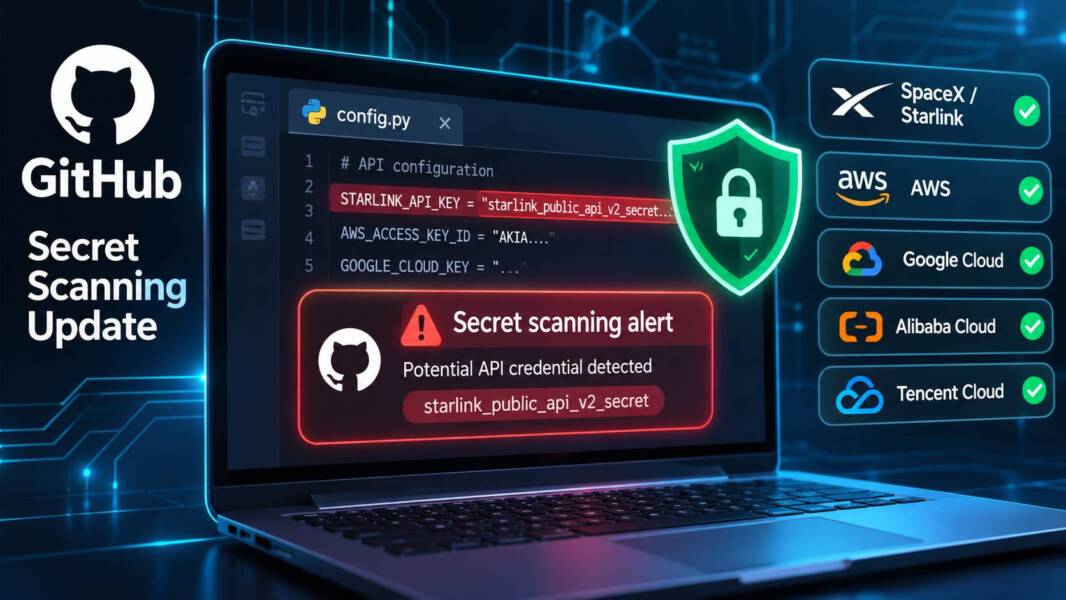
The changes address two important problems in software supply-chain security: detecting credentials accidentally exposed in source code and ensuring that automated alerts distinguish genuine secrets from harmless identifiers or placeholder values.
According to GitHub’s official announcement, the new SpaceX detector recognizes starlink_public_api_v2_secret. GitHub also tightened existing patterns to suppress certain incomplete matches and unrelated strings.
GitHub Changelog
For developers and security teams, this is more than a routine list of supported providers. Accurate secret detection affects incident-response workload, the usefulness of automated security alerts and the time required to investigate exposed credentials.
What Changed in GitHub Secret Scanning on November 5?
The update contains three main changes: an additional secret scanning partner, a new credential detector and refinements to existing detectors.
| Provider | Change | Security relevance |
|---|---|---|
| SpaceX / Starlink | New starlink_public_api_v2_secret detector |
Identifies a newly supported credential type |
| AWS | Improved matching for access keys and session tokens | Reduces certain incomplete matches |
| Google Cloud | Improved matching for storage-related credentials | Avoids alerts when required companion values are absent |
| Alibaba Cloud | Refined access-key identification | Reduces unpaired detections |
| Tencent Cloud | Stricter identifier matching | Avoids matching unrelated alphabetic identifiers |
| OpenVSX | More precise legacy-token context matching | Reduces unrelated UUID matches |
| Pydantic Services | Refined Logfire token format recognition | Excludes some placeholders and public browser tokens |
These are GitHub-reported detector changes. The announcement does not provide a measured percentage improvement in accuracy or an estimate of how many credentials will be discovered because of the update.
SpaceX joins GitHub’s secret scanning partnership program
The most visible addition is SpaceX, through the starlink_public_api_v2_secret pattern.
GitHub’s secret scanning partnership program helps credential issuers respond when their supported secrets appear in public repositories. When GitHub identifies a matching partner secret in a public repository, it can notify the issuer so the credential can be revoked or rotated.
This differs from simply notifying the repository owner. Partner notification creates an additional response path involving the organization that issued the credential.
However, detection and notification do not guarantee that a compromised credential has already been revoked. A developer who discovers an exposed credential should still follow the issuer’s recommended rotation and incident-response procedures.
Why GitHub Secret Scanning Accuracy Matters
Secret scanning searches code and other supported repository content for strings resembling credentials, such as API keys, access tokens and private keys.
The challenge is that not every suspicious string is a usable secret.
Some credentials have distinctive prefixes and predictable formats. Others resemble ordinary identifiers. A random UUID, configuration value or example token may accidentally satisfy part of a detector’s pattern.
If a scanner generates too many incorrect alerts, developers spend time investigating harmless values. Repeated false positives can also make teams less responsive to genuinely dangerous findings.
The November update focuses heavily on this distinction.
AWS, Alibaba and Google Cloud: reducing unpaired matches
Several updated detectors account for credentials that are meaningful only when associated with companion values.
For example, some cloud authentication schemes use a key identifier alongside a corresponding secret. GitHub’s announcement describes cases where dictionary filtering removes all qualifying companion secrets, leaving an identifier that should not be reported as a complete matching credential.
The updated logic suppresses certain unpaired matches for AWS, Alibaba and Google Cloud patterns.
This is an important technical refinement. A detector should evaluate the structure and context of a credential rather than assume every matching identifier proves that an exploitable secret has been exposed.
It does not mean an access-key identifier is always harmless. Identifiers can still reveal information about an environment, and their exposure may warrant investigation depending on context.
Tencent, OpenVSX and Logfire: more precise formats
GitHub also refined matching for three other providers.
For Tencent Cloud, the detector now requires both letters and digits after the relevant token prefix. This helps exclude alphabetic identifiers that might otherwise resemble a credential.
For OpenVSX, GitHub tightened contextual matching for legacy access tokens to avoid interpreting unrelated UUIDs as secrets.
For Pydantic Services, the logfire_token detector now more closely follows the documented token length and character set. GitHub says this excludes certain placeholder values and public browser tokens.
These changes demonstrate why secret detection requires ongoing maintenance. Credential formats evolve, and patterns that initially appear reliable may produce unnecessary alerts when applied across millions of repositories.
How GitHub Secret Scanning Handles Exposed Credentials
There are several related but distinct security mechanisms in GitHub’s secret protection ecosystem.
Partner secret scanning identifies supported credentials in public repositories and notifies participating issuers.
User secret scanning alerts notify repository administrators or authorized security personnel when supported secrets are found in repositories covered by the relevant feature.
Push protection can prevent certain secrets from entering repository history by rejecting pushes that contain supported patterns.
These mechanisms should not be treated as interchangeable. A newly supported detector does not automatically imply that every repository will block that credential during a push.
GitHub’s November 5 announcement confirms partner detection for the new Starlink credential type, but it does not announce default push protection for that pattern.
Developers should consult GitHub’s supported secret scanning patterns documentation for current feature coverage and availability.
Detection is not the same as prevention
A credential discovered after being committed may already have been copied into repository clones, build logs, archived artifacts or other systems.
Deleting the string from the latest source file does not necessarily eliminate the risk.
For a confirmed exposed credential, the safer response is generally to revoke or rotate it, assess its permissions and usage, and investigate whether unauthorized activity occurred.
Rewriting Git history can help reduce continued exposure, but it cannot guarantee that previously distributed copies have disappeared.
What Developers Should Do After the GitHub Secret Scanning Update
Most repositories will not require code changes solely because GitHub improved its detection patterns. Nevertheless, the update provides an opportunity to verify that credential-protection controls are configured correctly.
1. Review existing secret scanning alerts
Open the repository’s security interface and review active secret scanning findings.
Prioritize credentials that may still be valid, particularly those with access to production systems, cloud resources, deployment infrastructure or sensitive data.
Do not automatically dismiss an alert simply because it appears in an old commit.
2. Verify push protection settings
Where supported by the repository’s plan and configuration, enable push protection for relevant credential types.
Push protection is valuable because it can stop a secret from entering repository history in the first place.
GitHub has also been expanding context-aware detection. Its October 28 announcement introduced a public preview of push protection for AI-detected secrets, subject to feature eligibility and enablement requirements.
GitHub Changelog
That earlier development complements the November detector improvements: one expands the kinds of secrets that may be identified, while the other improves the precision of specific known patterns.
3. Remove credentials from application source code
Applications should obtain sensitive credentials from appropriate secrets-management mechanisms rather than embedding them directly in source files.
Depending on the deployment environment, options may include managed cloud secrets services, CI/CD secret stores or carefully controlled runtime configuration.
Environment variables can be useful, but they are not automatically secure. Their values can still leak through logs, debugging tools, misconfigured processes or exposed configuration files.
4. Apply least-privilege access
Where supported, use credentials restricted to the minimum permissions and resources necessary.
A token that can only read one service presents a different risk from a credential with administrative access across an entire cloud account.
Prefer short-lived credentials and workload identity mechanisms when the platform supports them.
5. Review automated development workflows
CI/CD systems frequently need credentials to access package registries, cloud infrastructure and deployment services.
Those credentials should not be exposed to untrusted pull requests or unnecessarily broad workflow permissions.
This connects to TechnologyHQ’s earlier article on GitHub SSH security changes, which explains how changes in authentication infrastructure can affect automated development systems.
The broader lesson is that protecting credentials requires attention to both storage and execution context.
GitHub Secret Scanning and the Wider Software Supply Chain
A modern software project may depend on multiple cloud platforms, source-code repositories, package registries, CI/CD systems and observability services.
Each integration can introduce credentials with different formats, lifetimes and permissions.
A single repository might contain references to AWS deployment keys, Google Cloud storage credentials, package publishing tokens and telemetry service credentials.
This diversity makes comprehensive detection difficult.
GitHub’s expanding partnership program helps address the problem by connecting supported credential issuers with the platform where accidental exposure frequently occurs.
But the system remains dependent on detector coverage, feature configuration and timely incident response.
The November update also complements improvements to static application security analysis. TechnologyHQ recently examined CodeQL 2.27.4 and its code scanning accuracy changes.
CodeQL and secret scanning solve different problems. CodeQL analyzes source code for potentially vulnerable patterns and data flows; secret scanning looks for exposed authentication material. Neither replaces the other.
A mature security pipeline benefits from both, alongside dependency monitoring, secure build configuration and runtime protections.
What the November Update Does Not Mean
The release should not be interpreted as evidence that GitHub can now identify every exposed credential.
GitHub supports many known secret formats, but proprietary tokens, unusual encodings and newly introduced credential schemes may require additional detection approaches.
Likewise, improved false-positive filtering does not prove that every remaining alert is a genuine security incident.
The announcement does not establish that SpaceX or Starlink suffered a breach. Adding a credential provider to a scanning program is a preventive security measure, not evidence of an actual compromise.
It also does not establish that GitHub’s updated detectors have independently verified performance gains across all repositories.
Those distinctions are important when evaluating vendor security announcements.
Frequently Asked Questions
What is new in GitHub secret scanning?
On November 5, 2026, GitHub announced a new SpaceX/Starlink credential detector and improved false-positive filtering for several cloud and developer-service credentials.
Does GitHub now detect Starlink API secrets?
Yes. GitHub added the starlink_public_api_v2_secret pattern and SpaceX joined its secret scanning partnership program.
Will the update automatically block Starlink credentials during a push?
GitHub’s announcement confirms detection and partner notification but does not state that default push protection was enabled for this new pattern.
Why might some existing secret scanning alerts disappear?
Detector refinements can exclude incomplete credential pairs, unrelated UUIDs, placeholder values or other strings that previously matched too broadly.
A disappearing alert does not prove that the associated application or infrastructure has changed.
What should I do if a real API key is exposed?
Revoke or rotate the credential, investigate possible unauthorized use, review its permissions, and replace hard-coded secrets with a suitable secrets-management solution.
The Bottom Line
The latest GitHub secret scanning update strengthens software supply-chain security through a combination of broader credential coverage and more precise detection.
SpaceX’s addition expands the partnership program, while refinements to AWS, Google Cloud, Alibaba, Tencent, OpenVSX and Pydantic Services patterns should reduce specific categories of false positives.
For developers, the practical priority remains unchanged: prevent credentials from entering source code, investigate genuine exposures promptly, rotate compromised secrets and ensure automated workflows use appropriately restricted access.
Better detection makes those processes more manageable, but it does not replace them.

Ingrid Maldine is a business writer, editor and management consultant with extensive experience writing and consulting for both start-ups and long established companies. She has ten years management and leadership experience gained at BSkyB in London and Viva Travel Guides in Quito, Ecuador, giving her a depth of insight into innovation in international business. With an MBA from the University of Hull and many years of experience running her own business consultancy, Ingrid’s background allows her to connect with a diverse range of clients, including cutting edge technology and web-based start-ups but also multinationals in need of assistance. Ingrid has played a defining role in shaping organizational strategy for a wide range of different organizations, including for-profit, NGOs and charities. Ingrid has also served on the Board of Directors for the South American Explorers Club in Quito, Ecuador.